Independent evidence review · AUGUST/SEPTEMBER 2026
Microplastics Evidence Review
What has been detected — and what has been proved
An 87-page assessment of microplastics, human health, exposure, analytical methods, accumulation, toxicology and real-world risk — based on more than 700 studies spanning >60 years of science. That Q&A style report is for the public.
An even more extensive 167 page review of over 1500 studies aimed at scientists can be found below as well as dedicated reviews on microplastics & bottled beverages and microplastics in connection with tap water.
Reviewed by independent experts in medicine, toxicology, polymer science and engineering. No external funding.
The central distinction
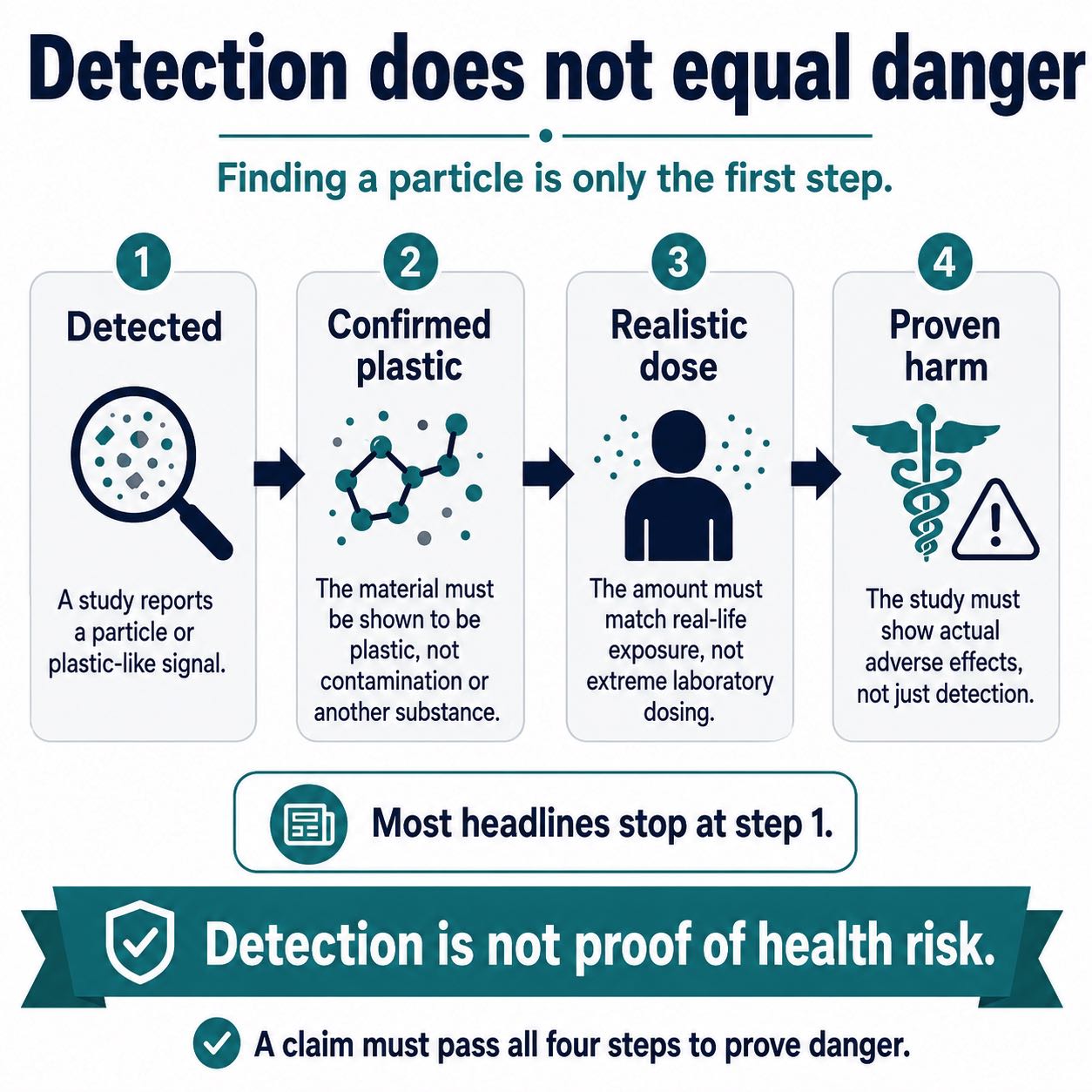
Detection is the first step. It is not the conclusion.
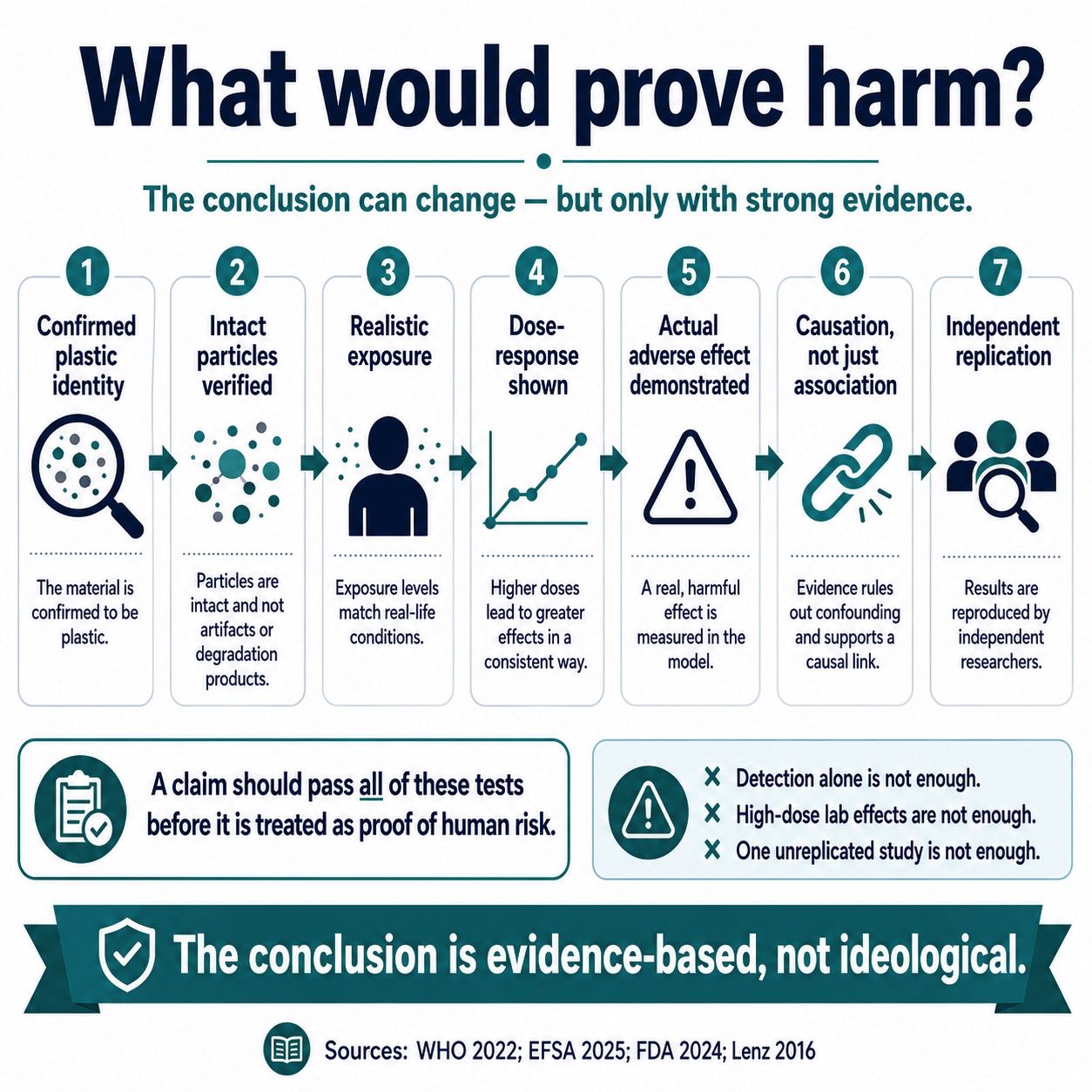
Microplastics can be reported in air, water, food, dust and biological samples. A valid health-risk claim must go further: it must confirm that the material is plastic, establish a realistic dose, show meaningful retention or biological exposure, and demonstrate harm caused by the particles.
The evidence in brief
What the review concludes
The report applies the same standards to reassuring and alarming studies. Its conclusions distinguish measurement from risk, particle count from dose, association from causation, and laboratory hazard from real-world exposure.
Normal exposure has not been shown to cause health effects
Decades of evidence does not show health effects caused by ordinary real-world exposure to common plastic particles.
Particle count is not the same as dose
Risk assessment requires identity, size, mass, exposure route, retention and biological effect. Very large counts can still represent negligible mass.
Plastic is a very small part of total particle exposure
People routinely encounter much larger backgrounds of mineral, cellulose, food, textile, skin, pollen, soot, metal and other particles.
Many laboratory studies do not represent real life
Common limitations include extreme doses, artificial polystyrene beads, forced exposure routes, weak controls and inadequate contamination prevention.
Meaningful accumulation has not been demonstrated
Most ingested particles are expected to pass through the body. Detection in stool is evidence of elimination, not proof of accumulation or harm.
Human health claims are unfounded
Findings involving blood, brain, placenta, arteries, fertility, cancer and dementia do not show causal harm from normal exposure.
Exposure in context
Scale matters
The report uses mass balance and realistic exposure comparisons to test whether dramatic particle-count or body-burden claims are physically and toxicologically plausible.
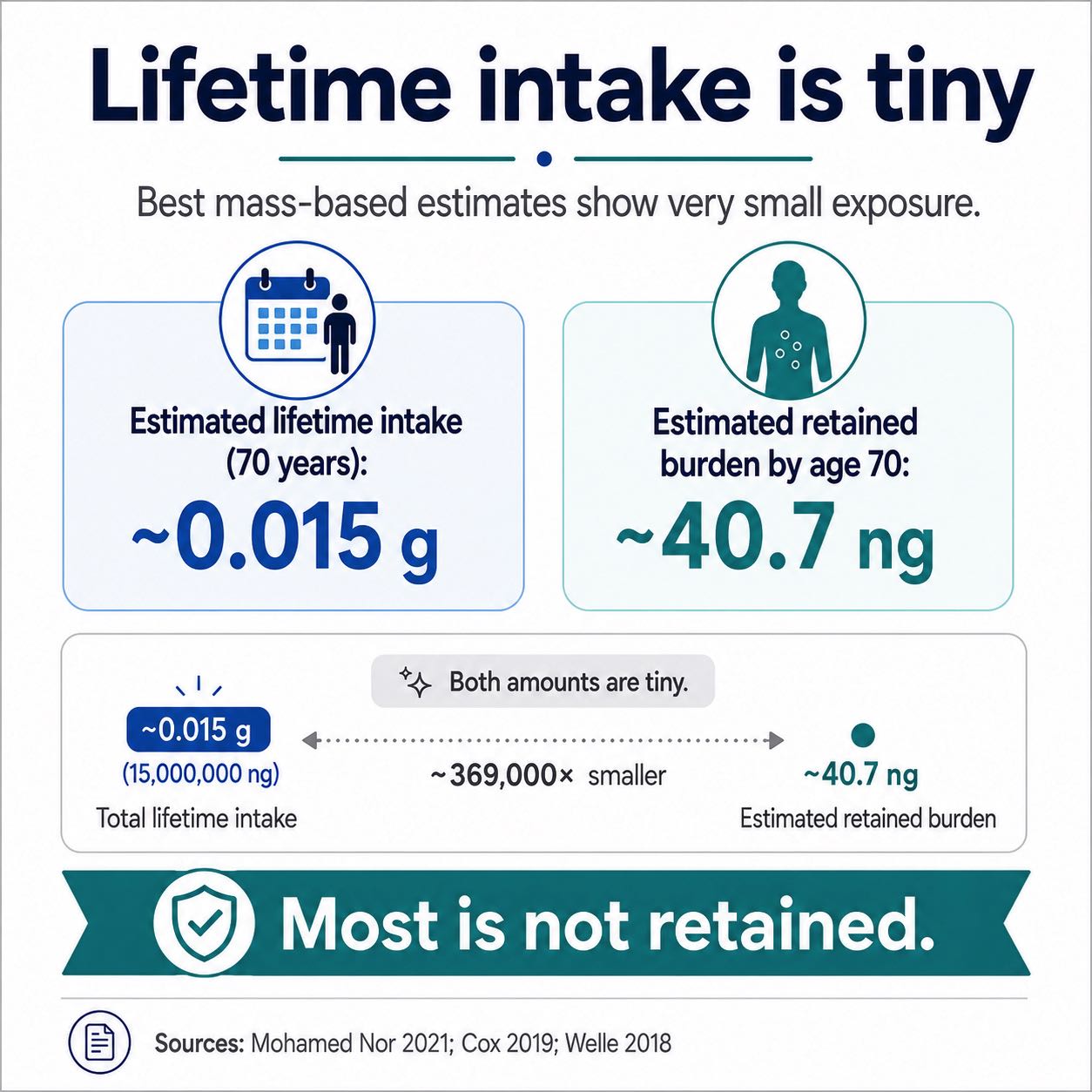
Modeled lifetime intake and retained burden are tiny by mass
A mass-based model cited in the report estimated median adult intake at approximately 583 ng/day, about 0.015 g over 70 years before elimination, and a modeled tissue burden of approximately 40.7 ng by age 70.
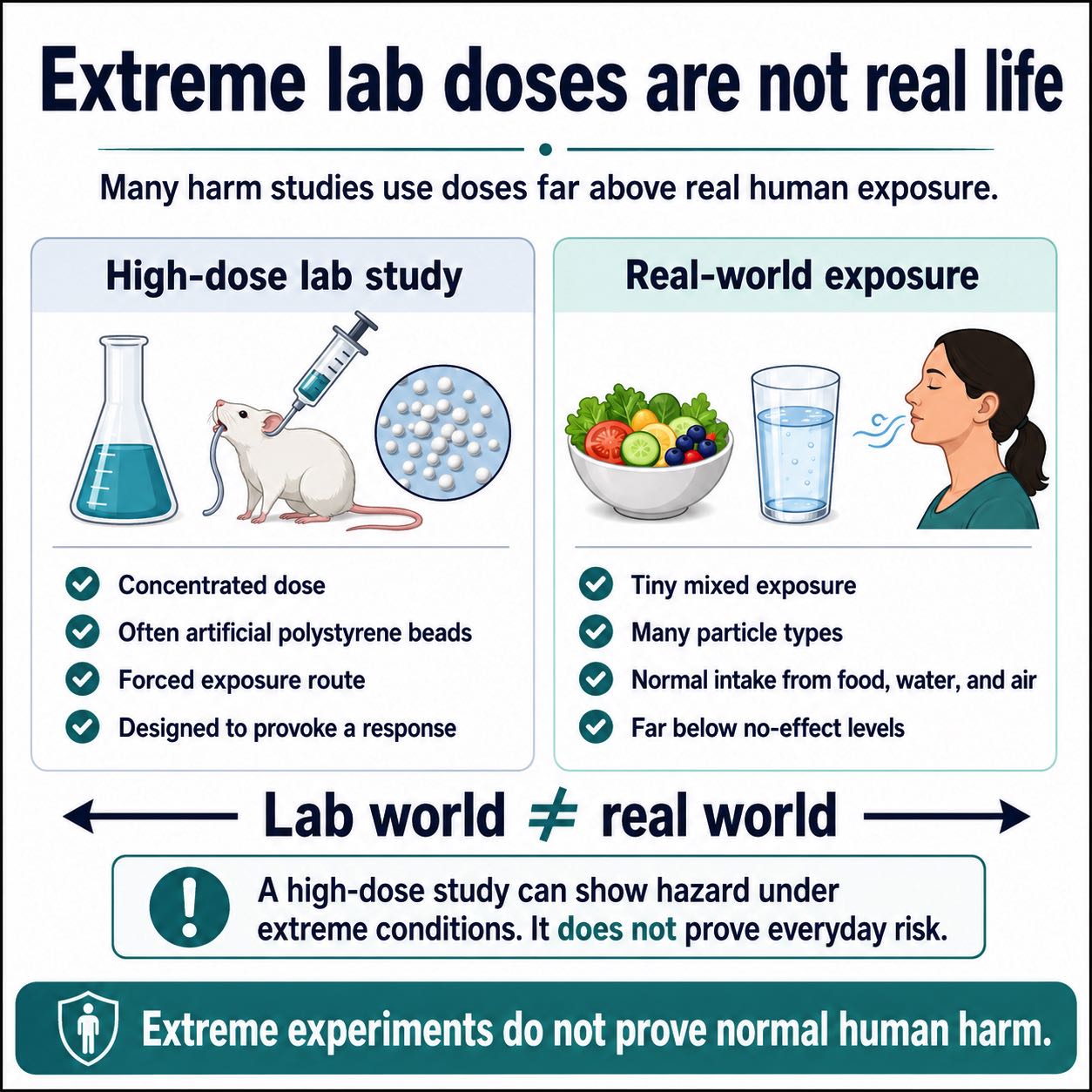
High-dose hazard studies do not establish everyday risk
Experiments using concentrated doses or artificial particles can identify possible mechanisms. They do not, without realistic dose and exposure conditions, demonstrate harm from normal human exposure.
A consistent evidence standard
Ten questions applied throughout the review
A study is not accepted or rejected because its result appears favorable or unfavorable to plastics. It is judged by whether its methods and conclusions support the claim being made.
Was the material confirmed as plastic?
Screening signals and visual appearance are not enough.
Were intact particles demonstrated?
Were contamination controls adequate?
Was the dose realistic?
Were the particles realistic?
Was the exposure route realistic?
Was mass measured as well as count?
Was harm shown, or only detection?
Was causation shown?
Was the result independently replicated?
The evidence does not divide into “pro-plastic” and “anti-plastic.” It divides into stronger and weaker evidence.
Full scope
The report addresses the claims people actually encounter
Each topic is evaluated using the same questions about identity, contamination, dose, mass, retention, biological effect, causation and replication.
Exposure, toxicity and real-world risk
Human health
How much people encounter, how exposure compares with no-effect levels, and why high-dose hazard is not the same as everyday risk.
Blood, brain, lungs, placenta and other tissues
Human body
What body-location studies detected, what their methods can prove, and why detection must not be converted into accumulation or disease.
Food, water, packaging and household sources
Everyday exposure
Bottled and tap water, seafood, tea bags, cutting boards, baby bottles, containers, filters and common source claims.
Methods, false positives and evidence quality
Measurement
FTIR, Raman, Py-GC/MS, Nile Red, contamination, size limits, spectral matching and what each technique can and cannot prove.
Cardiovascular disease, cancer, dementia and fertility
Health outcomes
Whether the strongest publicized studies establish causal disease from normal microplastic exposure.
Agency positions, regulation and precaution
Policy context
How FDA, WHO, EPA and EFSA frame current evidence, research needs, methods and risk conclusions.
Start with the key findings
For the public
Read this section →
Use the report and suggested citation
Download and cite →
Review the evidence audit and agency context
For policymakers
Open the audit table →
Examine methods, sources and correction policy
For scientists
Review the sources →
Dr. Chris DeArmitt
Polymer scientist; Fellow of the Royal Society of Chemistry; Fellow of the Institute of Materials, Minerals and Mining; Chartered Chemist; Founder of the Plastics Research Council.
Scientific review and transparency
Reviewed by independent scientific and technical experts
The reviewers examined scientific accuracy, balance, evidence quality, interpretation of the cited literature and clarity of the conclusions.
Dr. S Eliza Lockwood, MD, DFACMT
Leslie Patton, PhD, DABT
Professor Gary E. Wnek
Professor Tom Iseley, PhD, P.E.
Paul Wheeler, PhD
Reviewer listing indicates approval for the report to be released with the reviewers’ names, credentials and affiliations shown. It does not imply formal endorsement by each reviewer’s employer or institution unless explicitly stated. All conclusions remain those of the Plastics Research Council.
Open to better evidence
What would change the conclusion?
The report’s conclusion is not ideological or permanent. It should change if high-quality evidence demonstrates harm at realistic exposure.
Read the complete evidence review FOR SCIENTISTS
Download the full report
This 167-page PDF includes a fully technical evidence synthesis covering 1,661 canonical records. This version is aimed at scientists who want to know more than could be covered in the public Q&A style report above.
Read the complete evidence review ON MICROPLASTICS AND BOTTLED BEVERAGES
Download the full report
This report reviews the peer-reviewed science on microplastics in bottled beverages, both PET and glass.
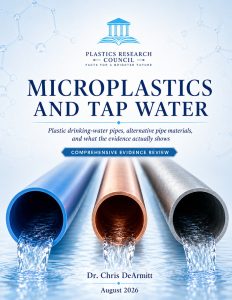
Read the complete evidence review ON MICROPLASTICS AND TAP WATER
Download the full report
This report reviews the peer-reviewed science on microplastics from tap water.
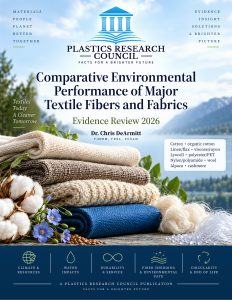
Read the complete evidence review ON FIBERS & TEXTILES
Download the full report
This report reviews the impact of fibers & textiles on the environment.
Read the complete evidence review ON PHTHALATES
Download the full report
This report reviews the peer-reviewed science on phthalates