
Plastics Research Council
Food, Water, and Household Sources
Jump to a section
Are microplastics in food dangerous?
Bottom line: No credible evidence shows that typical microplastic levels in food are dangerous.
Food naturally contains many particles and biological materials. The relevant question is not whether a few particles can be found. The relevant question is whether the dose is large enough to cause harm. That has not been shown. Amounts consumed are extremely low (0.01g over 70 years) compared to the safe dose (NOAEL) of 50-100g per day.
Sources: FDA 2024; WHO 2022; EFSA 2016; Koelmans 2022; FAO 2017; DeArmitt 2025
Are microplastics in seafood a health risk?
Bottom line: No credible evidence shows that microplastics in seafood are a human health risk at normal consumption levels.
Microplastics can be reported in seafood, especially in digestive tracts. That does not prove danger. The key question is how much plastic is present in the edible portion, whether the particles are confirmed as plastic, and whether the dose causes harm. For example, several studies reported plastic particles in crabs, but it was found that they were not in the edible (meat) portion (Wu 2023). Low levels of microplastics (MP) in wild mussels indicate that MP ingestion by humans were found to be minimal compared to exposure via household fibres falling on the plate during a meal.
Sources: EFSA 2016; FDA 2024; WHO 2022; FAO 2017; Smith 2018; Hantoro 2019; Catarino 2018
Are microplastics in salt, beer, honey, milk, rice, meat, or vegetables dangerous?
Bottom line: Finding a few particles in food does not prove danger.
Food naturally contains countless particles and biological materials. Risk depends on dose and toxicity. Current evidence does not show that microplastics reported in foods cause human disease. Actual exposure is far below safe limits. Plastics and other particles are found in salt and attracted attention. However, other studies found heavy metals including lead in salt but did not get public attention (Mohammadi 2025, Fayet-Moore 2020).
Sources: FDA 2024; WHO 2022; EFSA 2016; Toussaint 2019; Karami 2017; Mohammadi 2025; Fayet-Moore 2022
Are microplastics in bottled water dangerous?
Bottom line: No. Danger has not been demonstrated.
Some bottled-water studies report large particle counts, especially when very small particles are included. Counts are not the same as mass or risk. The important questions are whether the particles were accurately identified, how much mass was present, and whether that dose causes harm. Current evidence does not show that bottled-water microplastics are a health hazard.
Sources: NIH 2024; FDA 2024; WHO 2019, Welle 2018; Jüngling 2026; Schymanski 2018
What is the current state of the bottled-water nanoplastics claim?
Bottom line: Recent studies reported very high particle counts, but those counts do not prove danger.
A 2024 study reported roughly 110,000 to 370,000 micro- and nanoplastic particles per liter in three bottled-water brands using stimulated Raman scattering (Qian 2024). That is a particle-count claim, not a health-risk finding. The method is new, the result is an outlier, and the finding has not been independently replicated. Even if the count were correct, the plastic mass would be around 10 ng/L, or about 0.000000001% by weight, based on converting the reported particle counts and sizes into mass; that is comparable to trace quantities of the same food-contact plastics used to make bottles and caps (Qian 2024; Welle 2018; FDA 2024).
Sources: Qian 2024; NIH 2024; Jüngling 2026; Materic 2024; Qian Reply 2024; Ruggeri 2025
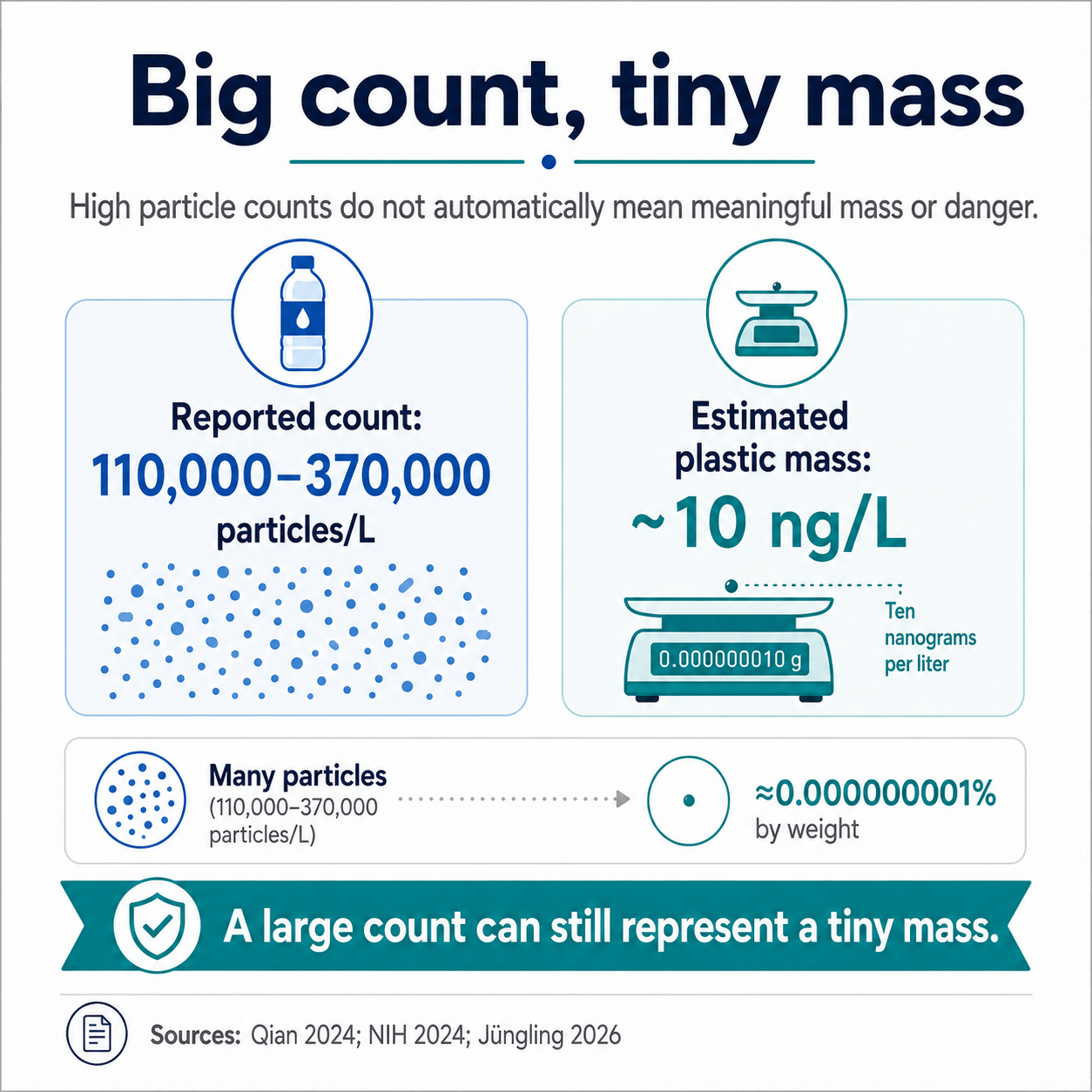
Nanoplastics have a Big Count But Tiny Mass
Is bottled water worse than tap water?
Bottom line: Sometimes bottled water reports higher particle counts, but health relevance has not been demonstrated.
Results vary by brand, bottle type, handling, lab method, blank correction, and particle-size cutoff. Reviews of tap and bottled-water studies show that reported occurrence is highly method-dependent and that the literature is not suitable for simple claims that one water source is consistently dangerous or that reported particles establish a health risk (Gambino 2022; WHO 2019; Koelmans 2019). Even if bottled water contains more particles than tap water in some studies, typical tap-water consumption is typically higher than bottled-water consumption and there is no health effect from plastic particles in either type of water. Plastic is the minority of particles in potable water, reported as low as about 0.4% of total particles in one recent analysis (Jüngling 2026). Several studies show that glass bottled beverages can contain substantially more microplastics or other particles than PET-bottled water (Schymanski 2018; Chaïb 2025; Reimann 2010; Krachler 2009). Furthermore, PET has lowest environmental impact for beverage containers (DeArmitt 2025).
Sources: Jüngling 2026; Schymanski 2018; Chaïb 2025; Welle 2018; Chaïb 2025; Reimann 2010; Krachler 2009, DeArmitt 2025; Gambino 2022; Yang 2024
Is glass-bottled water cleaner than plastic-bottled water?
Bottom line: Not necessarily.
Studies report more particles in glass-bottled beverages than in PET-bottled beverages. Packaging material alone does not determine particle exposure, and particles are not shown to be harmful.
Sources: Schymanski 2018; Chaïb 2025; Reimann 2010; Krachler 2009; Turner 2019
Does tap water contain microplastics?
Bottom line: Some studies report microplastics in tap water, but the amounts are generally small and risk has not been demonstrated because common commodity plastic particles have not been shown to be toxic at realistic exposure levels. Most particles are already removed by coagulation and filtration at water treatment plants. Plastic is the minority of particles in potable water, reported as low as about 0.4% of total particles in one recent analysis (Jüngling 2026). Tap water also contains many non-plastic particles, and reported microplastic levels vary strongly with sampling method, particle-size cutoff, analytical method, blank correction, and polymer-identification criteria (WHO 2019; Koelmans 2019; Yang 2024). A valid risk claim must identify the particles, quantify the dose by mass as well as count where possible, and show harm at realistic exposure. Mere detection is not enough.
Sources: WHO 2019; EPA Microplastics Research 2026, Jüngling 2026, Brancaleone 2024; Singh 2025, Velasco 2022 & 2023; Pivokonsky 2018; Pivokonsky 2020; Koelmans 2019; Mintenig 2019; Yang 2024
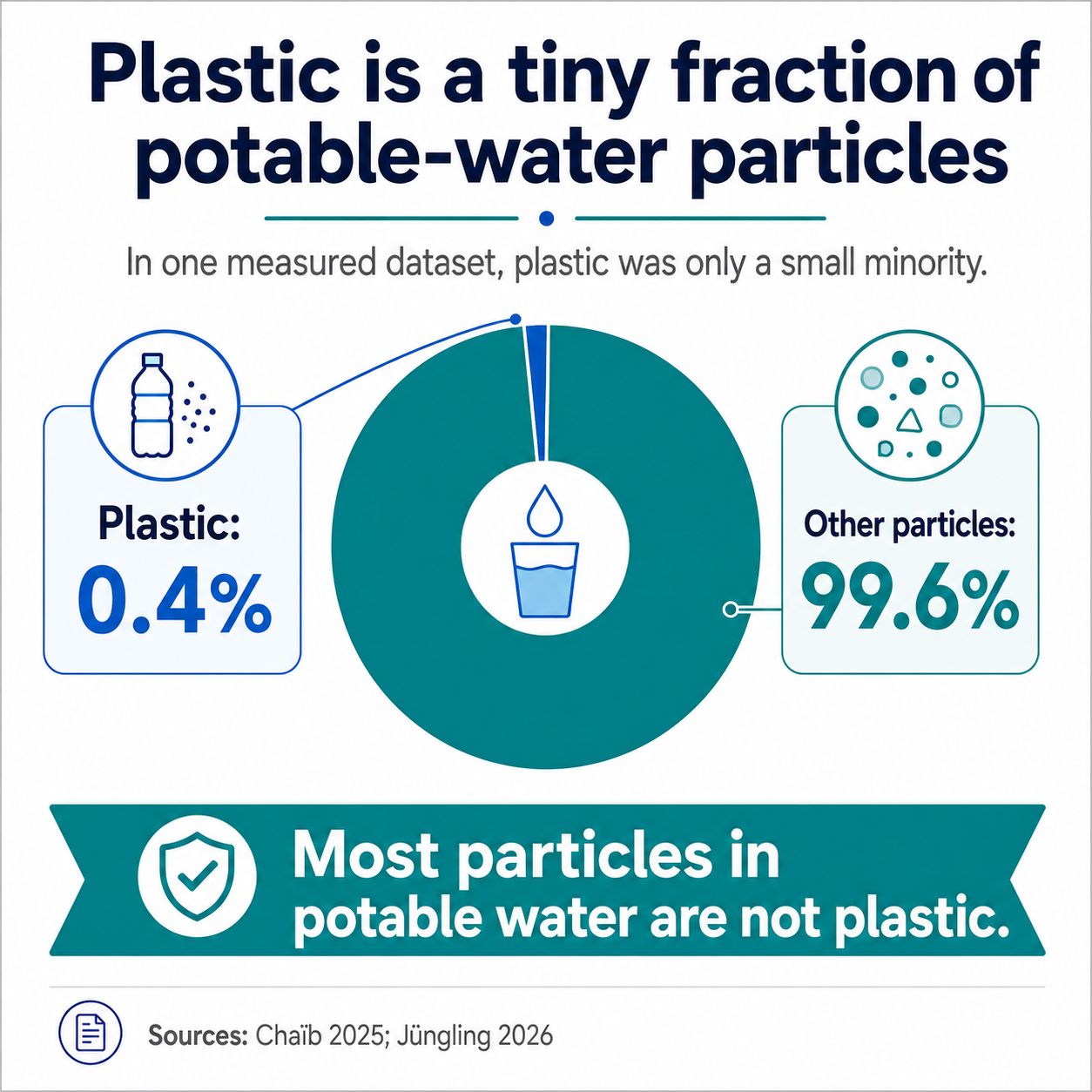
Microplastics are a Tiny Fraction of Particles in Potable Water Particles
Does ocean water contain microplastics?
Bottom line: Microplastics are present in ocean water, but the amounts are very low, and risk was found to be “negligible” (Beiras 2020). Of fibers in oceanic surface waters, natural fibers such as cellulosic and animal fibers were about 92%, whereas synthetic fibers were about 8% (Suaria 2020). None of the fibers are toxic under realistic conditions.
Sources: Beiras 2020; Suaria 2020; GESAMP 2016; Cozar 2014; Eriksen 2014
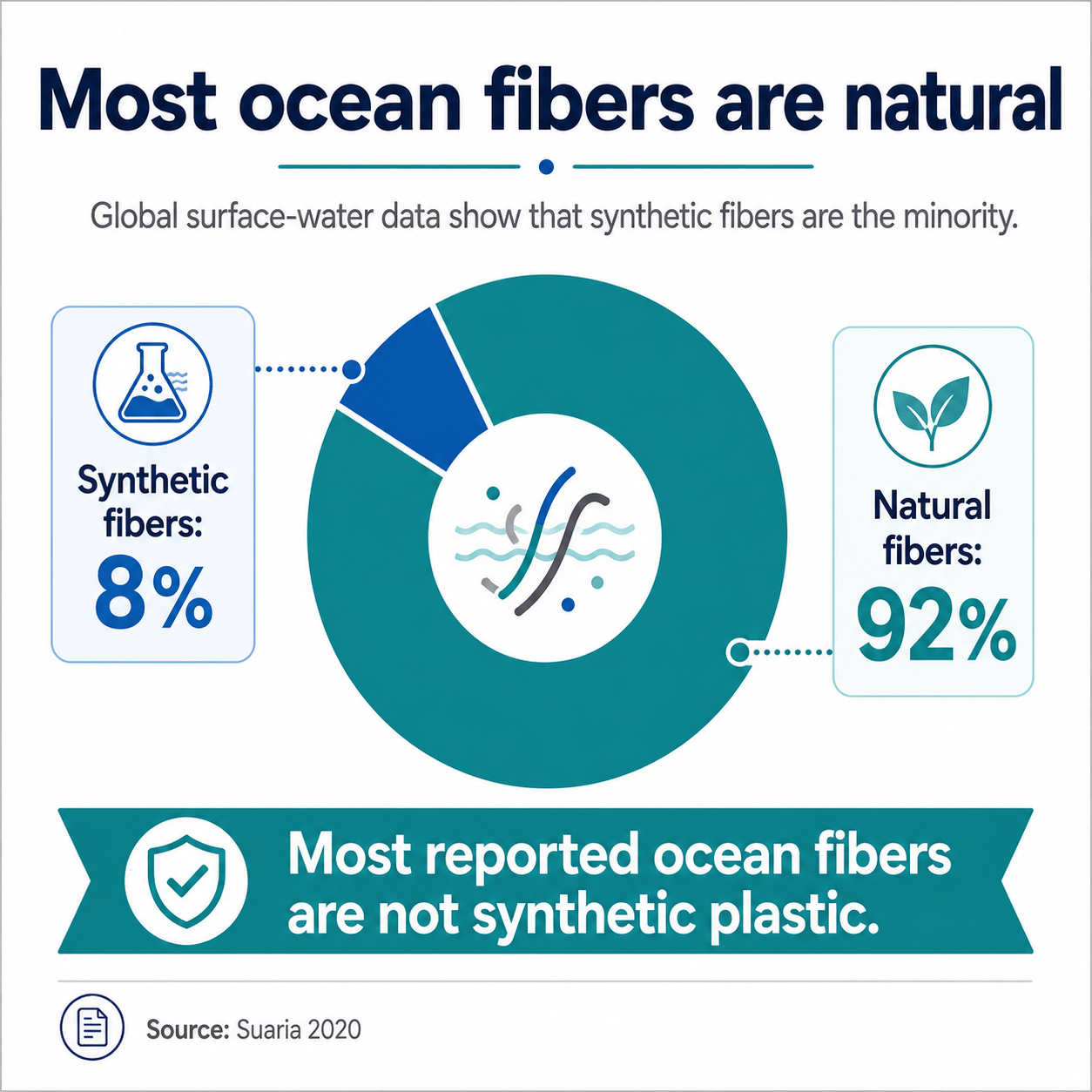
Most Ocean Micro Fibers Natural Not Synthetic Microplastic
Are microplastics increasing in the ocean?
Bottom line: Claims that ocean microplastics are increasing should be based on measured trends, not assumptions from rising plastic production or modelled leakage.
Measured ocean and wildlife data are variable, and trends differ by region, particle type, sampling method, and time period. One useful long-term indicator is plastic ingestion by seabirds and other marine animals. In Marine Anthropogenic Litter, Bergmann, Gutow and Klages summarize long-term seabird studies showing that industrial plastic pellets in seabird stomachs approximately halved from 1980s levels by the early 2000s after attention was paid to pellet losses during production and transport. The same chapter reports that, although plastic ingestion rose from the late 1950s into the 1970s and peaked in some studies around 1985–1995, the trend in plastic consumption decreased and stabilized from 2000 onward, approaching 1980s levels.
That does not mean there is no plastic in the ocean or that litter should be ignored. It means the evidence is more nuanced than the common claim that ocean plastic is simply increasing everywhere. Microplastic trend claims should separate measured data from model projections, should distinguish pellets, fragments, fibers, films, and fishing-related debris, and should report concentration, mass, particle size, and sampling method. Detection alone is not enough to show a worsening risk trend.
Sources: Bergmann, Gutow & Klages 2015; Van Franeker & Meijboom 2002; Moser & Lee 1992; Robards et al. 1995; Spear et al. 1995; Mrosovsky et al. 2009; Van Franeker et al. 2011; Bond et al. 2013
Are microplastics the main threat to marine animals?
Bottom line: No. Marine animals face many larger and better-proven risks.
Important risks include fishing gear, habitat loss, overfishing, disease, vessel strikes, and water quality. Microplastics should be kept in proportion to measured exposure and demonstrated effects. The estimated ecological risk from microplastics has been described as negligible in some assessments because measured concentrations are low relative to effect thresholds. (Beiras 2020).
Controlled fish-feeding studies also show why ingestion should not be confused with accumulation or harm. Lu et al. exposed juvenile yellow perch to high-density polyethylene microplastics through feeding and reported no mortality, no apparent signs of significant distress, no adverse effects, and no significant differences in growth performance; no accumulation of HDPE was detected in fish collected 24 hours after feeding. Alomar et al. exposed reared gilthead seabream to low-density polyethylene controlled diets and found that after one month of depuration, no microplastics were found in the gastrointestinal tracts, indicating no long-term retention in the digestive system. Fish-feeding studies are not direct proof of human safety, and they do not mean that all marine debris is harmless. They do show that the mere presence or ingestion of microplastic particles is not the same as demonstrated accumulation, toxicity, or population-level harm. Marine animals face larger and better-proven risks, including entanglement in fishing gear, habitat loss, overfishing, disease, vessel strikes, water-quality problems, and ingestion of large debris. Microplastics should therefore be evaluated by measured exposure, realistic dose, particle type, retention, and demonstrated biological effect, not by the assumption that every ingested particle causes harm.
Sources: Lu 2022; Alomar 2021; FAO 2017; GESAMP 2016; Beiras 2018; Beiras 2019
Are tire-wear particles microplastics?
Bottom line: Tire-wear particles are often grouped with microplastics, but they are chemically different from ordinary plastic packaging particles.
Tire particles contain rubber, fillers, carbon black, metals, and additives. They should be evaluated separately from polyethylene, polypropylene, PET, and other common packaging plastics. The plastic particle testing shows no toxic effects under realistic conditions whereas tire rubber (which is not plastic) has shown toxic effects in fish due to release of an additive called 6PPD/6PPD-quinone (Tian 2021). Rubber particles are one of the most significant contributors to synthetic ocean particles (DeArmitt 2020).
Sources: Boucher & Friot 2017; Kole 2017; Wagner 2018; OECD 2021; Tian 2021; McIntyre 2021, DeArmitt 2020
Are paints and coatings a source of microplastics?
Bottom line: Paints and coatings can contribute polymer particles to the environment.
They are different from packaging plastics and should be evaluated separately by chemistry, dose, and exposure route. Mass-based surveys of marine microplastics also indicate that paint and protective coatings can be important contributors. Dibke et al. used Py-GC/MS/thermochemolysis to measure microplastic mass in German Bight waters and reported heterogeneous concentrations and polymer distributions consistent with a potential contribution from marine coatings and ship paint.
Sources: Gaylarde 2021; Turner 2021; Boucher & Friot 2017; GESAMP 2016; Dibke 2021
Do water filters remove microplastics?
Bottom line: Some home filters can remove particles, but performance depends on the filter type and particle size.
Reverse osmosis and membrane systems should remove many particles above their effective pore size. Simple filters vary. No filter should be marketed as a health necessity as there is no evidence of health effects from plastic particles in water. Particles are already removed by coagulation and filtration at water treatment plants.
Sources: Cherian et al. 2023; EPA, Velasco 2022 & 2023; Pivokonsky 2018; Pivokonsky 2020; Velasco 2023; WHO 2019; Cherian 2023
Which water-filter technologies have validated removal data across the full microplastic and nanoplastic size range?
Bottom line: No simple home-filter claim should be accepted unless the filter was tested for the relevant particle sizes.
Water-treatment plants already remove many particles through coagulation, settling, and filtration. Home filters can remove additional particles if their technology and pore size are appropriate, but performance varies by device. There is no scientific reason to present home filtration as a medical necessity for microplastics.
If a household has a real water-quality problem, it should be addressed based on measured contaminants, not fear of plastic particles.
Sources: EPA Lead and Copper Rule; Cherian et al. 2023; Velasco 2022 & 2023; DeArmitt 2023; Velasco 2023; Li 2024; Cherian 2023
Does boiling water remove microplastics?
Bottom line: Boiling does not destroy plastic, but boiling hard water may reduce some particles if scale forms and the water is filtered afterward. There is no scientific or health reason to do so.
A 2024 study reported that calcium carbonate scale formed during boiling hard water can trap some nano- and microplastics. This is not a universal solution. It depends on water hardness, particle type, and filtration after boiling. Kettles can release metals such as nickel, as well as Pb, Ni, Mn, Cr, and Zn, so that should be considered.
Sources: Yu et al. 2024; Berg 2000; Müller 2015; Müller 2015
Are nanoplastics more dangerous than microplastics?
Bottom line: There is no evidence showing that normal nanoplastic exposure is dangerous.
Smaller particles are harder to measure accurately. Nanoplastic methods are less mature than methods for larger particles. Claims about nanoplastics should be treated carefully as large numbers of particles can be an insignificant mass of particles.
Sources: WHO 2022; EFSA 2025; Koelmans 2022; Gigault 2021
Do plastic cutting boards release microplastics into food?
Bottom line: Plastic cutting boards can release particles when cut or scraped.
That does not prove danger. The important issue is how much mass is released and whether that realistic dose causes harm. Cutting-board claims should be compared with all other food particles and with hygiene risks from alternative materials.
Sources: IARC 2012; EFSA 2025; Yadav 2023
Are plastic cutting boards dangerous compared with wooden boards?
Bottom line: Danger has not been demonstrated from normal plastic cutting-board use.
A fair comparison must include particle release, food safety, cleaning, bacterial contamination, durability, splintering, and actual exposure. The existence of particles alone does not make plastic boards unsafe. Wood dust can cause cancer if breathed in whereas plastic particles are non-carcinogenic. Some studies report antibacterial effects for certain woods, but food-service use also depends on sanitation, surface condition, cleaning method, and regulatory requirements, which is why professional kitchens use plastic cutting boards which can be thoroughly cleaned in a dishwasher.
Sources: Yadav et al. 2023, IARC 2012; Yadav 2023; IARC 1995
Do tea bags release microplastics?
Bottom line: Some polymer-containing tea bags can release particles when heated, but this does not imply harm.
The risk depends on how much material is released by mass, whether the particles are actually plastic, and whether the dose causes a biological effect. Particle counts alone can exaggerate concern, EFSA reviewed this topic and found methodological errors in some tea bag studies.
Sources: EFSA 2025; Hernandez 2019
Are black plastic utensils a microplastics issue?
Bottom line: Mostly no. Recent black-plastic concerns are mainly about chemical additives and recycled-material contamination, not microplastic particles.
Chemical-additive questions should be handled separately from microplastic-particle questions. Mixing the two creates confusion.
Sources: Kuang 2018; Liu 2024; FDA food-contact materials; Hahladakis 2018
Does heating plastic containers release microplastics?
Bottom line: Heat and abrasion can increase release from some plastics, but normal use has not been shown to create a microplastic health hazard.
A practical message is simple: follow the product instructions, do not overheat items not intended for heating, and replace badly damaged containers. That is sensible use, not evidence of a proven microplastic disease risk.
Sources: EFSA 2025; Li 2020; Akbulut 2024; Ranjan 2021
Does plastic food packaging make food unsafe?
Bottom line: No. Plastic packaging is not made unsafe by microplastic claims.
Packaging protects food, reduces spoilage, lowers contamination risk, and often reduces environmental impact compared with heavier alternatives. Any claimed particle release must be judged by dose and evidence of harm, not fear of plastic itself. Food packaging and containers must comply with FDA or other regional food contact regulations.
Sources: FDA 2024, EFSA 2025; Welle 2018; Meng 2024; Voulvoulis 2019
Are glass and other alternatives particle-free?
Bottom line: No. Switching away from plastic does not mean switching to a particle-free world.
All solid materials can shed particles during manufacture, use, breakage, abrasion, weathering, or handling. Glass is a clear example. Studies of medical glass ampoules show that opening glass ampoules can introduce glass particles into injectable solutions. Chiannilkuchai and Kejkornkaew reported glass-particle contamination in 449 of 672 ampoules examined, with thousands of particles counted and many in the small-particle size range. Eul Joo et al. reported that 180 tested glass ampoules contained 19,473 glass particles, averaging more than 100 particles per ampoule. Perez et al. described glass ampoules as a high-risk source of particulate contamination because fragments can be introduced when the ampoule is opened and can pass through a needle into a syringe. Yorioka et al. found significantly more small particles after cutting glass ampoules than plastic ampoules for glycyrrhizin injections. These examples are not about ordinary drinking-water exposure, and they do not mean glass is uniquely dangerous. They show a narrower but important principle: particles are a property of solid materials and handling processes, not a problem unique to plastics. Therefore, claims about “microplastics” should be compared with the full particle context, including glass, mineral, metal, cellulose, pigment, and other non-plastic particles.
Sources: Chiannilkuchai 2021; Eul Joo 2016; Perez 2016; Carraretto 2011; Yorioka 2009
Do plastic baby bottles release microplastics, and is that dangerous?
Bottom line: Some studies report particle release from plastic baby bottles under certain preparation conditions. That does not prove harm.
Infant products should be used according to instructions. Any risk claim must compare realistic dose with evidence of biological harm.
Sources: Li 2020; FDA 2024; WHO 2022; EFSA 2025
Do disposable cups, coffee lids, and takeout containers release microplastics?
Bottom line: Heat, abrasion, and repeated use can release small particles from some materials. That does not prove a health hazard.
The key question is the dose by mass and whether it causes harm. Current evidence does not show that normal use of food-contact plastics creates a microplastic health hazard.
Sources: Ranjan 2021; Akbulut 2024; EFSA 2025; FDA 2024
Are compostable or biodegradable plastics safer for microplastics?
Bottom line: Not automatically.
Biodegradable or compostable plastics can still form particles if conditions are not suitable for degradation. “Compostable” does not mean the material disappears instantly in the environment, and it does not automatically mean lower risk.
Sources: Piao 2024; Malafeev 2023; Chamas 2020; ISO 2020; SAPEA 2019
Do microplastics in soil harm crops or soil function?
Bottom line: Current field evidence does not show that realistic microplastic loadings in agricultural soil harm crop yield or key soil microbial functions.
Microplastics can persist in soil, especially where agricultural soils receive organic fertilizers, compost, biosolids, mulch-film residues, or other particle inputs. Persistence, however, is not the same as harm. The relevant question is whether measured or realistic soil concentrations impair crop growth, soil microbial biomass, enzyme activity, carbon cycling, or nutrient function. Schöpfer et al. studied arable soil under field-relevant agricultural conditions and reported that conventional and biodegradable microplastics could persist and accumulate, but current loadings had no detectable immediate negative consequences for soil microbial abundance, microbial activity related to carbon cycling, or crop yield. That is the appropriate distinction: detection in soil may justify monitoring and better source control, but it does not by itself prove ecological damage.
Some laboratory studies report soil effects, but many use simplified systems, high concentrations, artificial particles, or endpoints that do not translate directly into field-level crop loss. Reviews of soil microplastics show that occurrence, sources, and methods remain active research areas, but the evidence should be evaluated by concentration, particle type, exposure duration, soil properties, and real agronomic outcomes. The current evidence supports a proportionate conclusion: soil microplastics are worth measuring and reducing where practical, especially to avoid unnecessary contamination, but realistic soil levels have not been shown to be a major demonstrated cause of crop-yield loss or soil-function collapse.
Sources: Schöpfer 2022; Yang 2021; Li 2021
Do plastics degrade into microplastics, and do microplastics degrade further?
Bottom line: Yes. Plastics can fragment into microplastics, and microplastics can continue to chemically, physically, and biologically degrade. The rate depends strongly on polymer type, additives, oxygen, sunlight, heat, moisture, abrasion, surface area, microbes, and the surrounding environment.
Plastic degradation is not a single process. Weathering by sunlight, oxidation, heat, mechanical abrasion, hydrolysis, and microbial activity can weaken larger plastic items and cause fragmentation into smaller particles. For example, Weinstein et al. found that high-density polyethylene, polypropylene, and polystyrene degraded in salt-marsh habitat and concluded that surface delamination was a primary mechanism by which microplastic particles were produced during early degradation. Expanded polystyrene can also fragment rapidly outdoors under sunlight, producing micro- and nanoplastic particles. This means that macroplastic litter can become microplastic, just as other solid materials can fragment into dust and particles as they age.
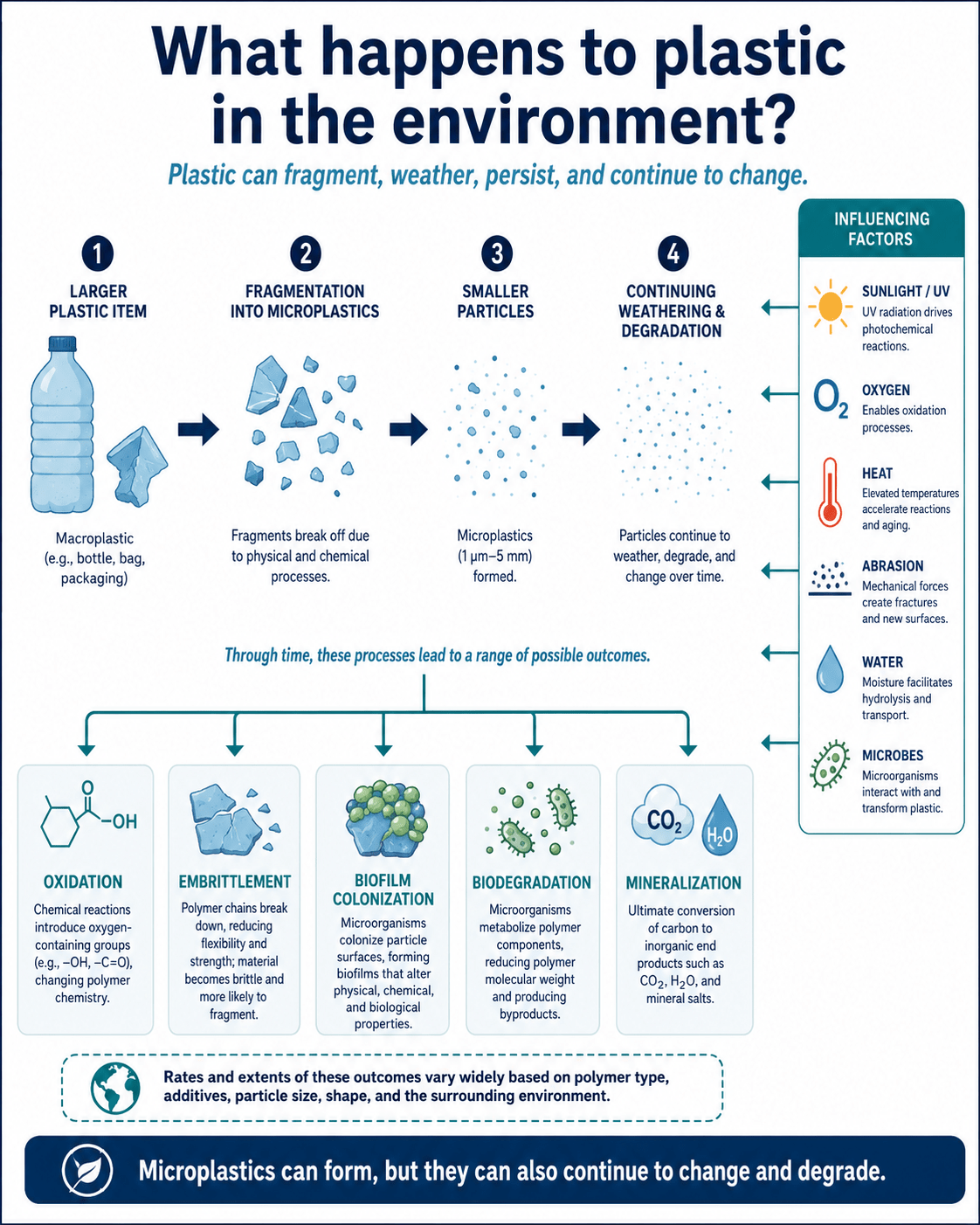
What Happens to Microplastic Particles in the Environment
The process does not necessarily stop at the microplastic stage. Microplastics have higher surface area than larger items and can continue to oxidize, crack, embrittle, fragment, and be colonized by microorganisms. Polyethylene and polypropylene are often described as persistent, but persistence does not mean permanent. Reviews and experimental studies report biodegradation or biodeterioration of polyethylene and polypropylene by bacteria, fungi, and mixed microbial communities, usually slowly and often more readily after weathering or other pretreatment. Jeon et al. reported long-term biodegradation of buried low-density polyethylene in soil, Arutchelvi et al. reviewed biodegradation evidence for polyethylene and polypropylene, Jeon et al. later reported biodegradation of polyethylene and polypropylene by a soil Lysinibacillus strain, and Vaksmaa et al. reported biodegradation and mineralization of polyethylene by a marine fungus after photodegradation.
The correct conclusion is therefore balanced: plastic items can fragment into microplastics, and microplastics can degrade further, but rates vary widely. Degradation can be fast for some materials and conditions, such as sunlight-exposed expanded polystyrene or biologically active environments, and slow for others, especially buried, cold, dark, oxygen-limited, or stabilized plastics. Environmental persistence is a reason to reduce unnecessary litter and improve waste management. It is not proof that every plastic particle is permanent, accumulating forever, or biologically harmful at realistic exposure levels.
Sources: Weinstein 2016; Jeon 1995; Arutchelvi 2008; Jeon 2021; Vaksmaa 2024; Kyoung 2020; Restrepo-Flórez 2014; Mohanan 2020
Do plastic pipes release microplastics into drinking water?
Bottom line: Real-world drinking-water studies do not show that PE or PVC pipe systems release measurable plastic particles into tap water at meaningful levels.
A useful example is the Danish tap-water study by Feld et al. The authors sampled drinking water from 17 geographically widespread locations in Denmark, including sites with different water abstraction areas, waterworks, groundwater ages, aquifer geology, and pipe-network materials. The supplementary site information shows that many of the sampled supply networks included plastic pipes, especially PE and PVC, often alongside other pipe materials.
Despite that, the study did not identify PE or PVC particles in the tap water. Across all samples, confirmed plastic particles were rare and consisted of PET, PP, PS, and ABS. For particles larger than 100 µm, all samples were below the limit of detection, and the observed MP-like particles could not be distinguished from background contamination. Most visually suspected particles were not plastic at all; µ-FTIR showed that most were cellulose, with some proteinaceous material and poor or unknown spectra. For the smaller-particle analysis down to 10 µm, only three MP fragments were identified in the subset tested: PET, PP, and ABS. Again, no PE or PVC particles were reported.
This matters because plastic pipes are often treated as an assumed source of drinking-water microplastics. Feld et al. tested actual tap water from real Danish distribution systems, including systems containing PE and PVC pipe, using contamination controls and chemical confirmation. The result does not prove that plastic pipes can never shed any particles under any condition, but it does show that in a broad real-world drinking-water system containing PE and PVC pipe, PE and PVC particles were not detected at measurable levels.
The more accurate conclusion is therefore not that “pipes release plastic into drinking water,” but that real-world tap-water measurements show very low plastic particle levels, often indistinguishable from background contamination, with no confirmed PE or PVC particles even where PE and PVC pipes are present.
Sun et al. provides an important supply-chain test of the claim that drinking-water pipes are a major source of microplastics. The study measured microplastics in raw water, treated water leaving drinking-water treatment plants, and household tap water after distribution through the pipe network. If the pipe network were a major net source of plastic particles, household water would be expected to contain more particles than the treated water entering the distribution system.
The opposite pattern was reported. Treated water contained more microplastics than household water, and the authors described the lower household-water concentrations as evidence of non-targeted removal during distribution, possibly because particles adsorb to pipe scale. In other words, the distribution system did not act as a net source of microplastic particles in this study; it appeared to reduce measured particle counts between the treatment plant outlet and household taps.
This does not prove that pipes can never release particles under any condition, and it does not identify the exact fate of each particle. However, it directly contradicts the simple claim that plastic drinking-water pipes necessarily add measurable microplastics to household tap water. In this real-world supply system, fewer particles came out of the distribution network than entered it.
Water-treatment and distribution systems contain many particle sources. The relevant comparison is total particle exposure and toxicity. Copper and metal pipe corrosion can release substances with known toxicity; plastic pipe particles have not been shown to create a health risk at normal exposure.
Sources: Świetlik & Magnucka 2024; WHO 2019; WHO 2022; Koelmans 2019; Feld 2021; Sun 2024
Do drinking-water pipes release only plastic particles?
Bottom line: No. Drinking-water distribution systems can generate and release many kinds of non-plastic particles, including mineral scale, corrosion products, metals, organic deposits, and biofilm-associated material.
Particles in tap water should not automatically be assumed to come from plastic pipes or plastic packaging. Drinking-water pipes are chemically and biologically active surfaces. Over time, pipe walls can develop scale deposits, corrosion layers, mineral precipitates, organic films, and biofilms. These deposits can act as both sinks and sources for particulate material in water. Wiercik et al. characterized scale deposits in drinking-water pipes using FTIR and ICP-OES and reported that such deposits contain inorganic and organic components, including mineral and metal-associated material. This reinforces a basic point for microplastics interpretation: when particles are found in tap water, they may be mineral scale, pipe corrosion products, metal oxides, biofilm-associated material, fibers, or other non-plastic debris. Polymer identification is therefore essential before calling particles “microplastics.”
This matters because many public claims treat particles in drinking water as if they are automatically plastic and automatically hazardous. That is not scientifically valid. Tap-water particles must be identified by composition, size, morphology, and source. Plastic may be present in some samples, but drinking-water systems also produce non-plastic particulate matter through normal scale formation, corrosion, precipitation, and biofilm processes. The correct conclusion is not “pipes release plastic”; it is that drinking-water systems are complex particle environments, and plastic identity must be proven rather than assumed.
Sources: Wiercik 2026; Makris 2014; González 2022; WHO 2019; Feld 2021