
Plastics Research Council
Microplastics Evidence Review
Introduction
The term and concept of “micro-plastics” predate the widely cited Thompson et al. 2004 paper. Ryan and Moloney explicitly studied “micro-plastic particles” on South African beaches in 1990, separating micro-plastics from macro-plastics and grouping them into industrial pellets, expanded polystyrene, and fragments of plastic articles. Their surveys found that plastics comprised 98% of micro-artefacts and that mean micro-plastic particle density increased from 491 m⁻¹ of beach in 1984 to 678 m⁻¹ in 1989. Thompson et al. 2004 later brought broader attention to microscopic plastic fragments and fibers, but the scientific study and terminology of micro-plastics were already present in the literature more than a decade earlier. It is worth noting that studies on plastic particles, including toxicology studies, were published decades before the word microplastics was coined.
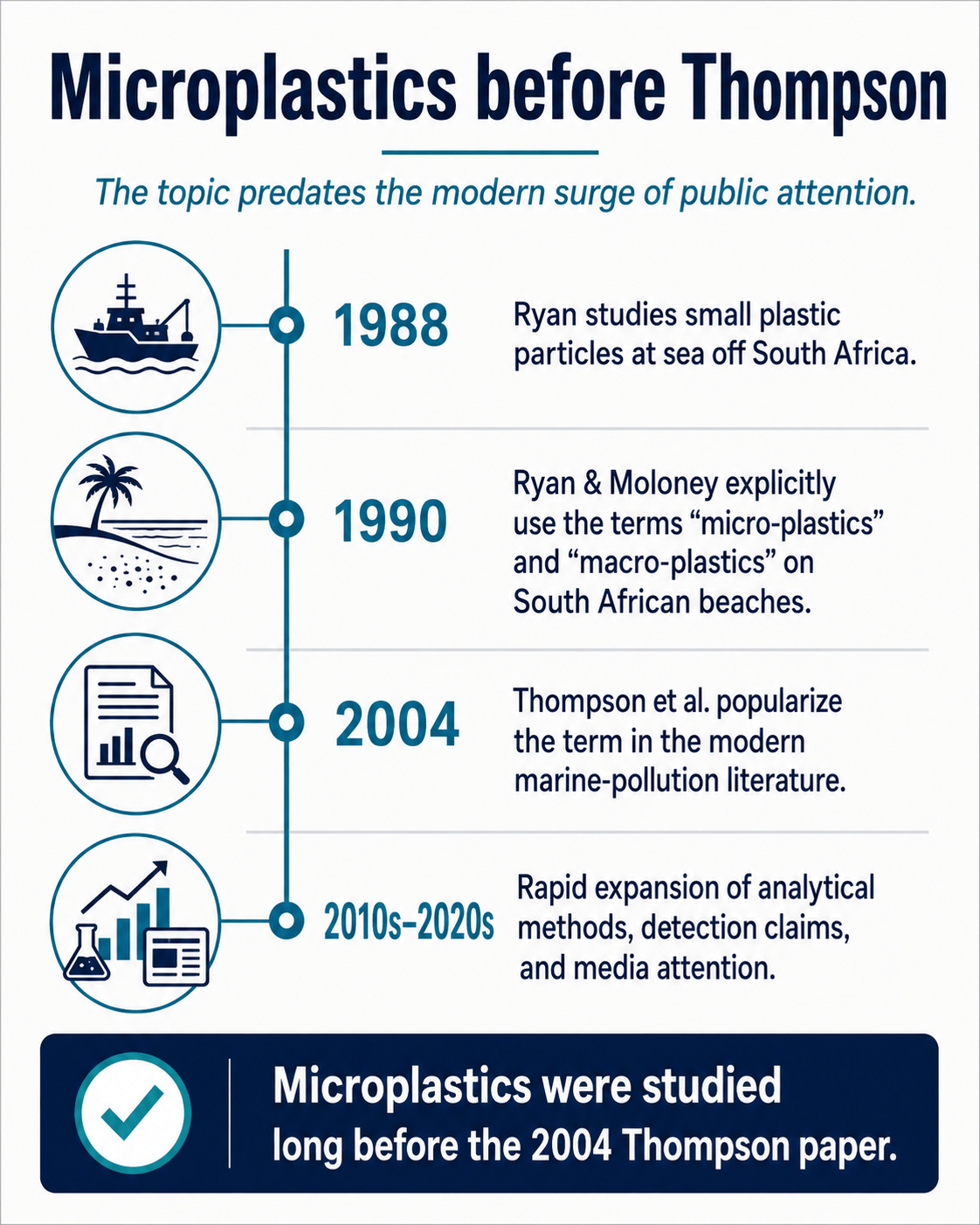
Microplastics Before Thompson
Microplastic: A solid plastic particle, fiber, or fragment smaller than 5 mm in its largest dimension, formed either intentionally at small size or by the breakdown of larger plastic items.
The term nanoplastic is applied to plastic particles below 1 micron in size.
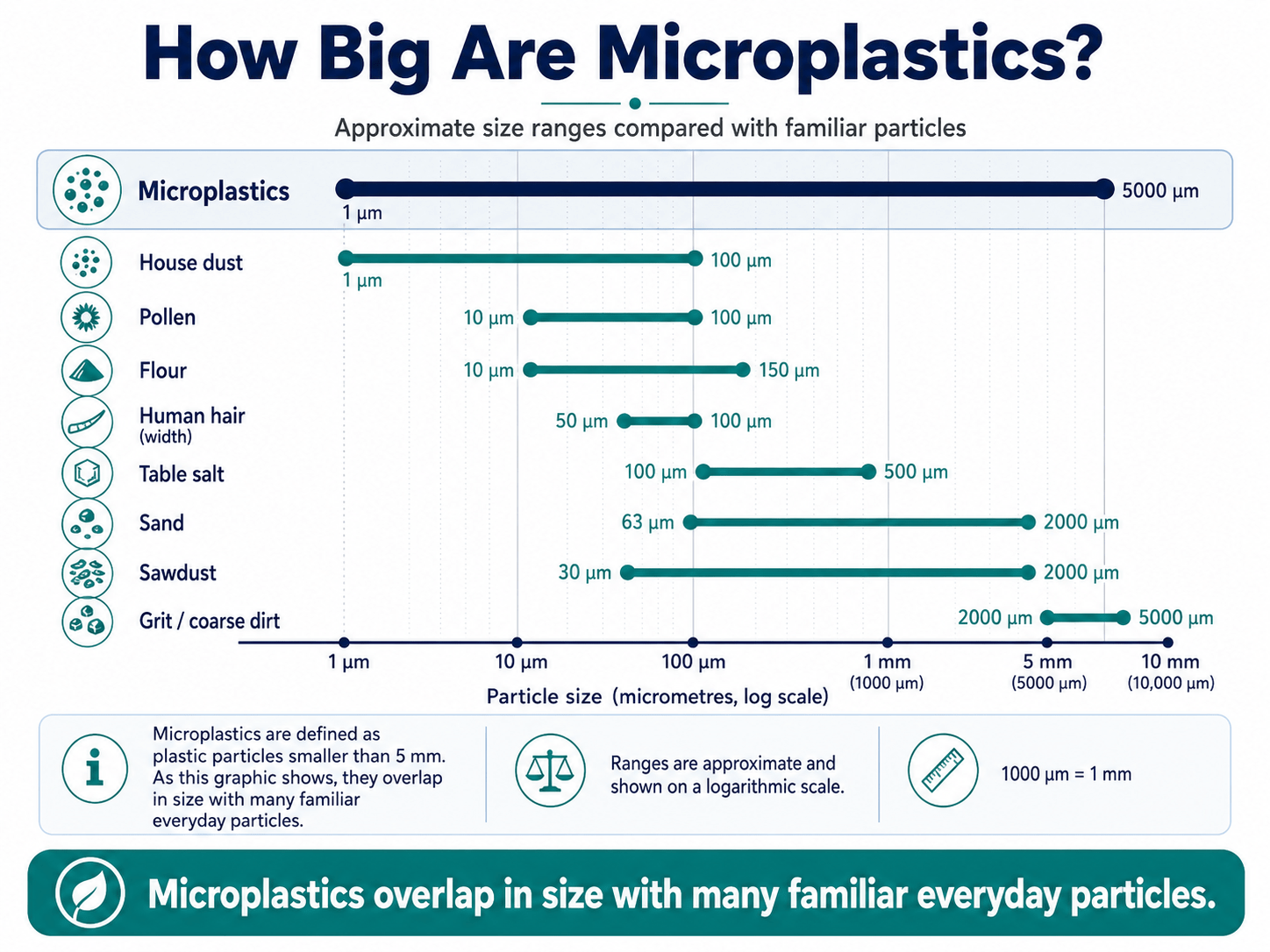
How Big Are Microplastics Compared
Particles are not unusual. They are an unavoidable consequence of living in a physical world. All solid materials wear, abrade, weather, corrode, fracture, crumble, or shed material over time. At small enough size, we usually call these particles dust. Concrete, soil, clay, paper, wood, skin cells, textile fibers, spores, pollen, metals, rust, glass, ceramics, paint, road dust, and even gold jewelry can release particles during normal use and aging. We should therefore not be surprised that sensitive analytical methods find particles almost everywhere: in air, water, dust, food, soil, buildings, vehicles, and biological samples. The important scientific question is not whether particles exist, but what they are, how much is present, whether the dose is realistic, whether the material has unusual toxicity, and whether harm has been demonstrated. Plastic particles are only one small subset of the total particle burden people and ecosystems encounter. They deserve special concern only if evidence shows that they are present at a meaningful dose and pose a hazard beyond the far larger background of mineral, organic, metallic, biological, glass, ceramic, and other non-plastic particles.
Sources: Mohamed Nor 2021; Heindel 2020; Gustafsson 2018; Mukherjee & Agrawal 2017; IARC 2012; WHO 2022; Ryan 1990; Thompson 2004
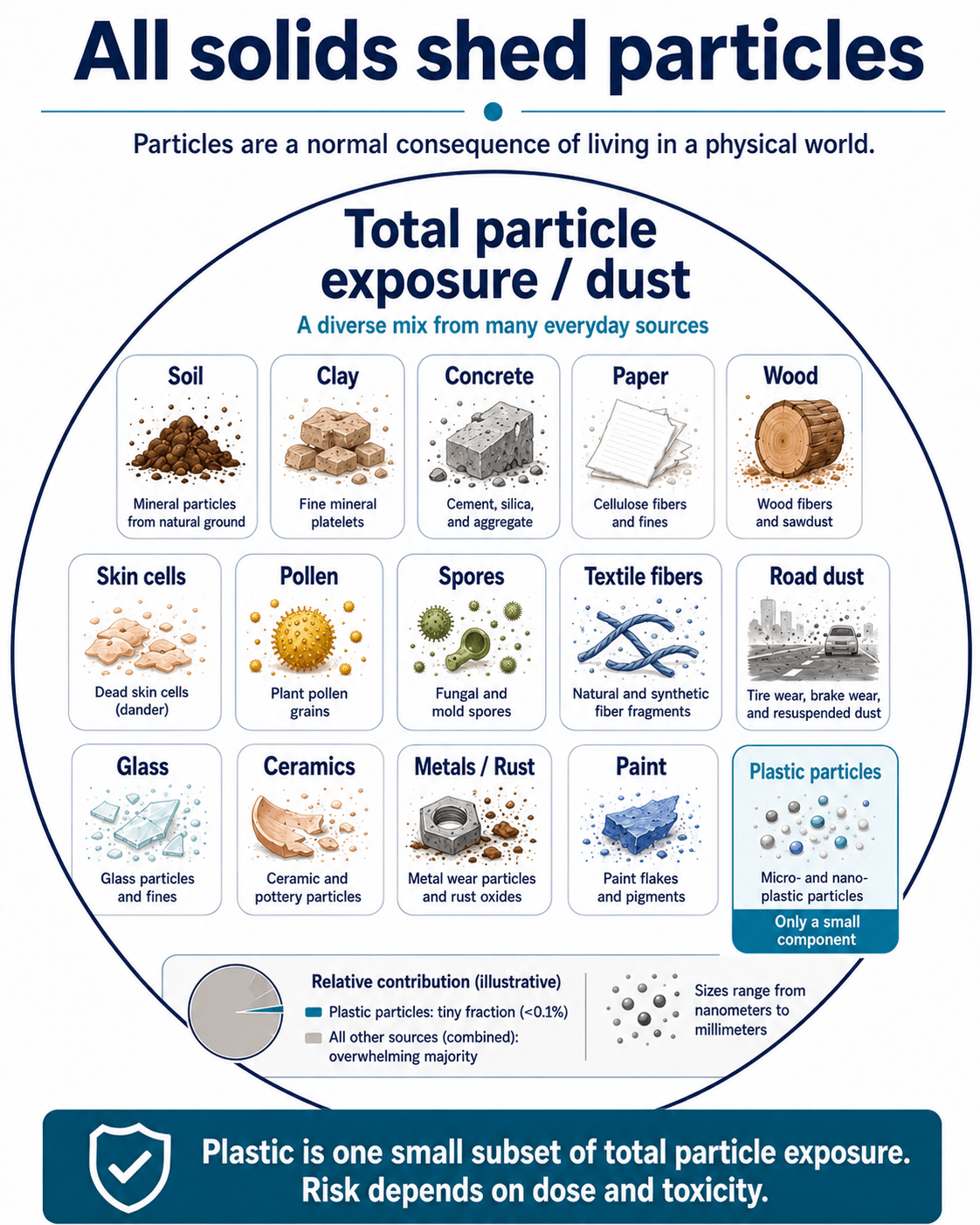
All Solids Shed Particles
How We Grade the Evidence
Not all microplastics studies are equal. Some studies deserve more weight because they use realistic exposure levels, validated analytical methods, strong contamination controls, confirmed particle identification, and conclusions that match the data. Other studies deserve less weight because they use extreme doses, artificial particles, weak controls, contamination-prone methods, or claims that go beyond what the experiment actually showed.
This review applies the same evidence-quality questions to all studies, whether the result appears favorable or unfavorable to plastics. The goal is not to defend a material. The goal is to separate strong evidence from weak claims.
The central rule is simple: a headline is not evidence. A study must prove what it claims to prove.
Core grading questions
> Did the study prove the material was plastic?
> Did it prove intact particles were present, not merely chemical fragments, dissolved substances, additives, or contamination?
> Were blanks, controls, and sample-handling procedures strong enough to rule out contamination?
> Was the exposure dose realistic compared with measured human or environmental exposure?
> Were the particles realistic, or were they artificial materials such as perfect laboratory polystyrene beads?
> Was the exposure route realistic?
> Did the study measure mass as well as particle count?
> Did it prove harm, or only detection?
> Did it prove causation, or only association?
> Has the result been independently replicated?
Evidence-quality scorecard
| Criterion | Stronger evidence | Weaker evidence |
|---|---|---|
| Particle identity | Polymer confirmed by a validated method with transparent quality criteria. | Dye staining, weak spectral match, or bulk chemical signal only. |
| Intact particles | Particle size, shape, and location are shown. | Only pyrolysis fragments or indirect chemical signals are reported. |
| Contamination control | Strong procedural blanks, clean sampling, and blank correction. | Weak or missing blanks; unclear handling; plastic-rich lab environment. |
| Dose realism | Exposure matches measured real-world levels. | Doses hundreds, thousands, or millions of times above real exposure. |
| Particle realism | Particles reflect environmental materials, sizes, shapes, and weathering. | Perfect spherical laboratory beads or polymers not representative of normal exposure. |
| Exposure route | Route matches human or environmental exposure. | Forced bolus, injection, cell bath, or other artificial route. |
| Dose metric | Mass, particle count, size, and polymer type are reported where possible. | Particle count alone, especially for tiny particles, with no mass context. |
| Biological outcome | Clear adverse effect at realistic exposure. | Stress markers, irritation, or cellular effects only at extreme doses. |
| Causation | The study shows the plastic caused the effect. | Detection or association is treated as harm. |
| Replication | Independent studies confirm the result. | Single unconfirmed study or method-development result. |
| Conclusion | The conclusion matches the data. | The headline or abstract overstates what was proved. |
Evidence grades
Strong: confirmed identity, strong contamination control, realistic exposure, relevant particles, evidence of harm if harm is claimed, and conclusions that match the data.
Moderate: useful evidence with limitations; enough to inform discussion, but not enough by itself to prove broad human health risk.
Weak: detection or hazard-screening evidence with major limits such as unrealistic dose, uncertain identity, weak blanks, artificial particles, or no replication.
Not proved: the claim is not supported by evidence strong enough for public-health or policy conclusions.
Why this matters
The strongest studies in this field are not the loudest studies. They are the studies that measure realistic exposure, prove what the particles are, control contamination, and avoid turning detection into disease.
Many alarming microplastics claims come from studies that would score poorly under normal toxicology or analytical-chemistry standards. That does not make those studies worthless. It means they should not be used to frighten the public or justify policy unless they actually prove real-world risk.
This is why this review emphasizes evidence quality. The evidence does not divide into pro-plastic and anti-plastic. It divides into strong science and weak science.
Sources: Lenz 2016; Koelmans 2019; Koelmans 2022; Gouin 2022; Cowger 2020; Hermsen 2018; EFSA 2025; WHO 2022
How this review handles contrary evidence
This review does not ignore studies that report detection or harm. It separates them into categories: confirmed exposure, uncertain detection, high-dose laboratory hazard studies, animal studies, association studies, and human evidence. A study is accepted only for what it actually proves. Detection is not treated as disease. Association is not treated as causation. High-dose laboratory effects are not treated as normal human risk.
How quantitative claims are sourced
For the most important numerical claims, the source is named immediately next to the number or sentence it supports. This makes it clear which study supports which claim and prevents readers from having to infer support from a general source list at the end of a section.
What is the difference between microplastics, nanoplastics, plastic additives, and dissolved chemicals?
Bottom line: Microplastics and nanoplastics are solid particles. Additives and dissolved chemicals are different, and exposure questions are separate.
Many public claims mix these categories together. A plastic particle is not the same thing as BPA, phthalates, PFAS, monomers, oligomers, dyes, pigments, or dissolved organic chemicals, in fact, most plastics like PE, PP, PET, uPVC do not contain BPA, phthalates or PFAS. Each claim should be judged separately by exposure, dose, and any evidence of harm.
Sources: EFSA 2025; FDA 2024; Hahladakis 2018; Hartmann 2019; Gigault 2021
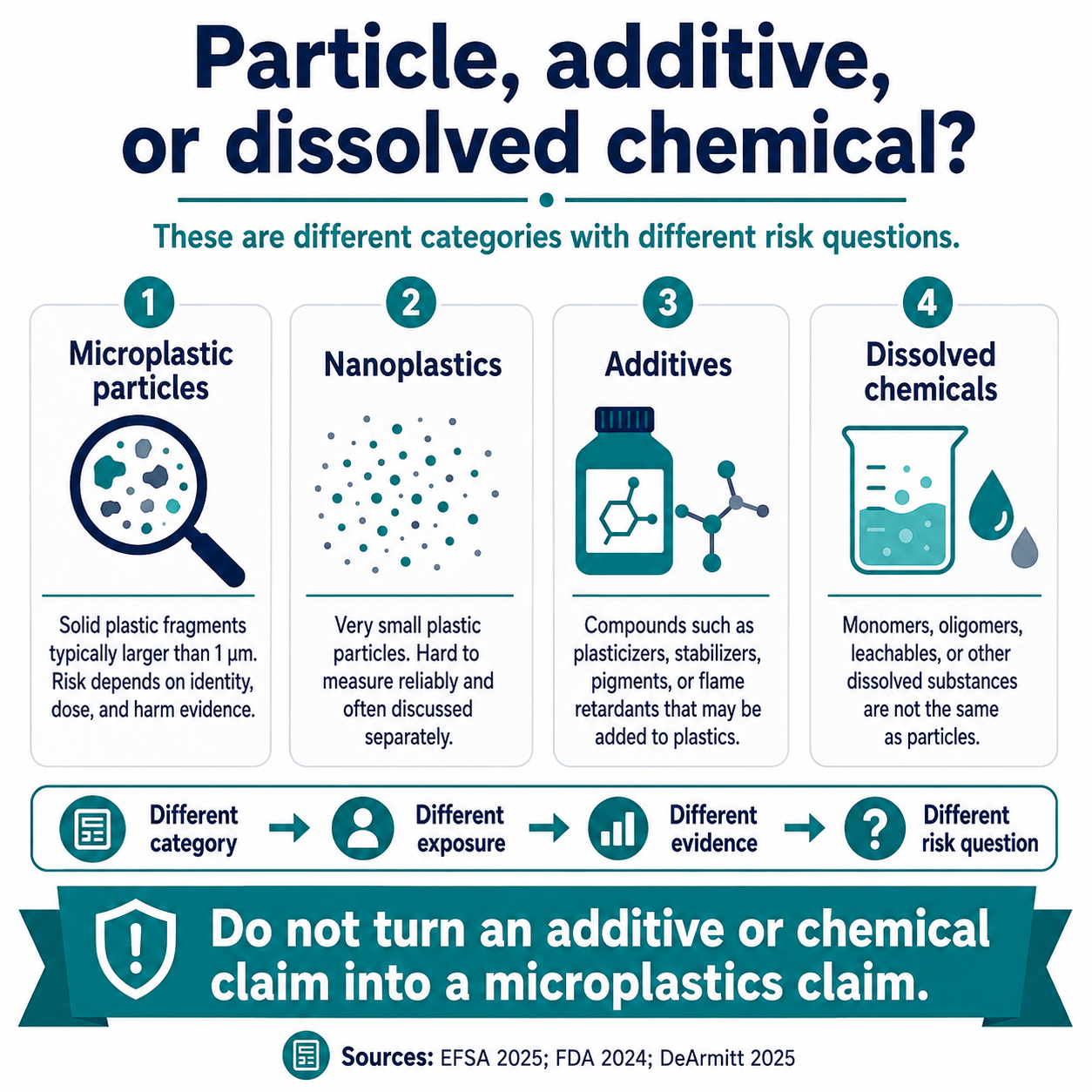
Particle Additive of Dissolved Chemical
Are all plastics the same?
Bottom line: No. Plastic is not one material.
Polyethylene, polypropylene, PET, PVC, polystyrene, nylon, acrylics, rubbers, coatings, and resins are different materials with different chemistries and uses. A claim about one plastic should not be applied to all plastics.
Sources: Gilbert/Brydson 2017; Hahladakis 2018; ISO 2020; Andrady 2011
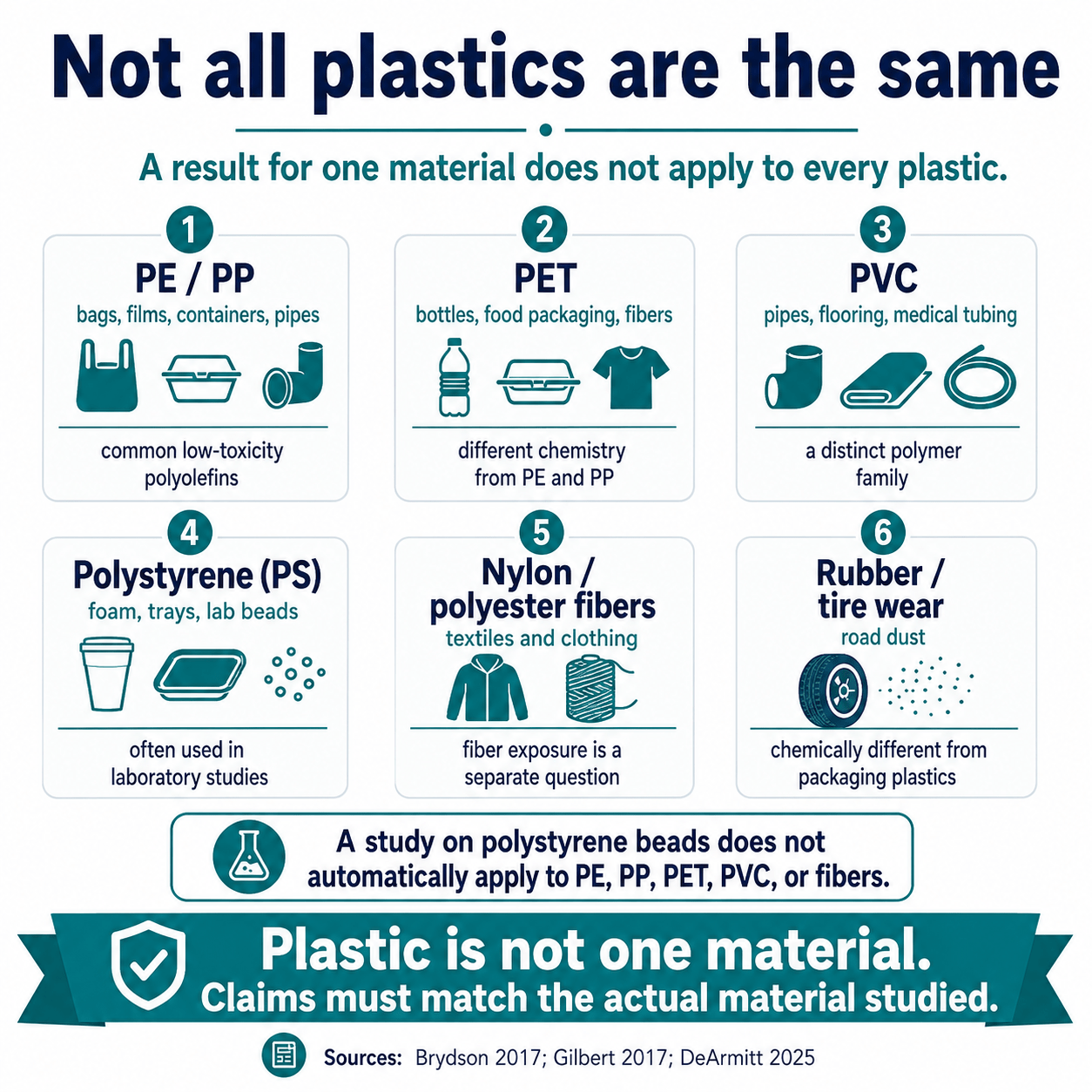
Not All Plastics are the Same
Key: PE – polyethylene, PP – polypropylene, PVC – polyvinyl chloride, nylon is polyamide 6 or 6,6
Are plastic particles different to other particles?
Bottom line: No. Plastic particles are not biologically or physically unique simply because they are plastic. Most claimed “microplastic mechanisms” — inhalation, ingestion, irritation at very high dose, inflammation, oxidative stress, chemical sorption, microbial biofilms, and environmental breakdown — are general particle behaviours shared by many other materials. Risk depends on dose, size, shape, density, surface chemistry, durability, bioavailability, and intrinsic toxicity, not simply on whether a particle is plastic.
Plastic particles can be inhaled or ingested, but so can dust, soot, pollen, mineral fragments, cellulose fibers, tire particles, metal particles, silica, and many other small solids. Once exposure occurs, the relevant toxicological question is not “is it plastic?” but “what is the dose, where does it deposit, how long does it remain, and does the material have hazardous chemistry or structure?”
Several mechanisms often described as special properties of microplastics are not special to plastics:
Particle irritation or inflammation: At sufficiently high doses, many poorly soluble particles can overwhelm clearance systems and cause inflammation or oxidative stress. This is a general particle-overload phenomenon, not a plastic-specific mechanism.
> Chemical sorption: Plastics can sorb hydrophobic chemicals, but so can soot, black carbon, clay, organic matter, fibers, sediments, and minerals. In real environments, natural particles and food usually dominate chemical exposure compared with microplastic-mediated transfer.
> Biofilms and microbes: Microbes can colonize wet surfaces. Plastic can host biofilms, but so can metal, glass, minerals, natural fibers, plant matter, sediments, and biological tissue.
> Environmental movement: Plastic particles move according to the same basic physics as other particles: size, density, shape, turbulence, settling, buoyancy, aggregation, and surface fouling determine transport.
> Degradation: Plastic particles can weather, fragment, oxidize, and biodegrade. The rate varies by polymer and environment, but “particle breakdown over time” is not unique to plastic.
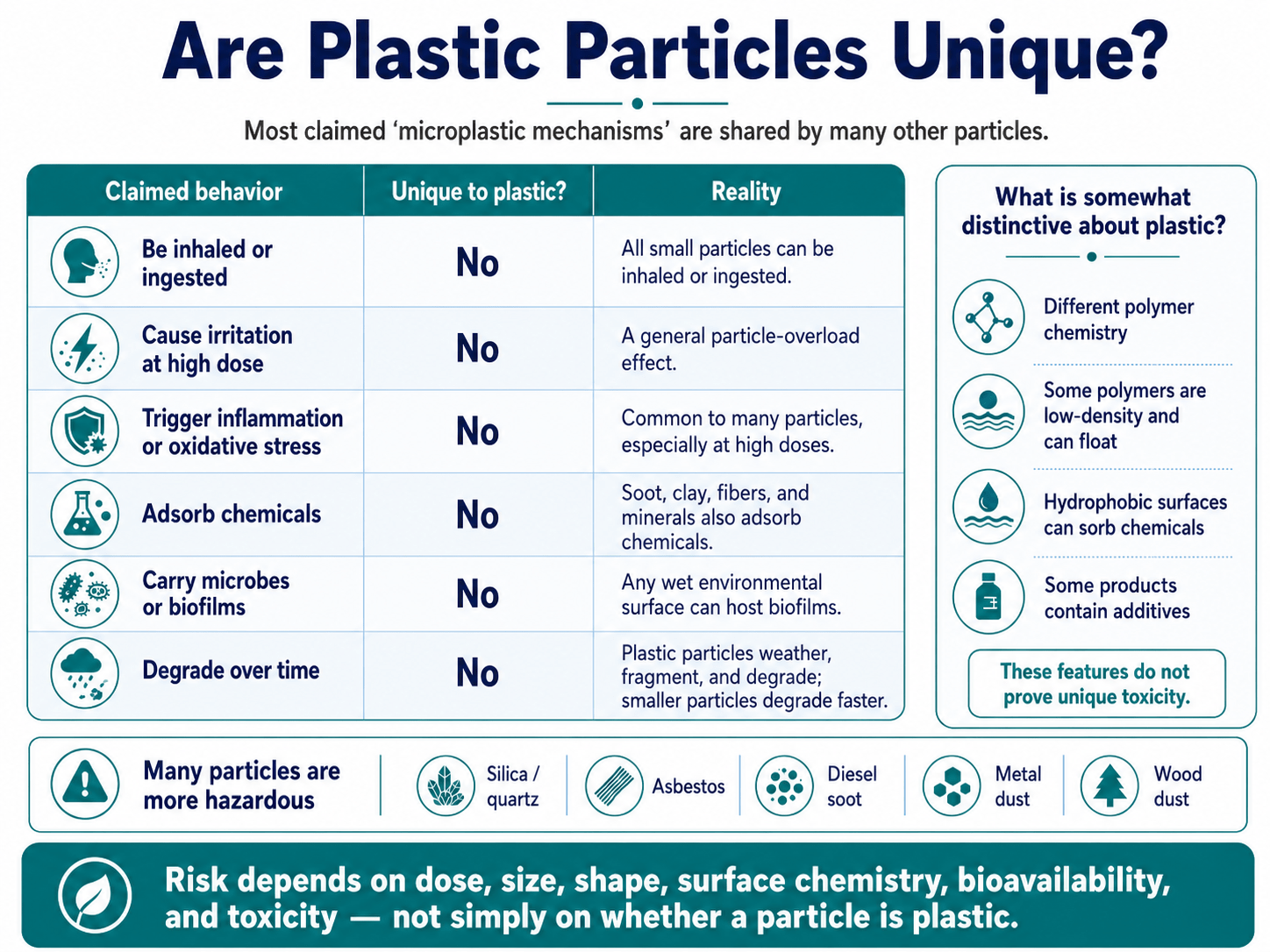
Are Plastic Particles Unique
The scientific implication is important. There is no known hazard-relevant physical property commonly attributed to microplastics that is not also found in other common dust and environmental particles. Small size, irregular shape, surface area, hydrophobicity, surface charge, chemical sorption, biofilm formation, inhalation, ingestion, translocation, environmental transport, and persistence are all shared by other particles such as mineral dust, soot, pollen, spores, cellulose fibers, road dust, metal particles, glass, ceramics, pigments, clay, and organic matter. Therefore, the prior probability that ordinary plastic dust is uniquely toxic at normal real-world exposure levels is low. A claim of plastic-specific toxicity must show realistic dose, confirmed particle identity, meaningful retained burden, biological harm, and a clear effect beyond the much larger background of non-plastic particles.
What is somewhat distinctive about plastics is their polymer chemistry, but polymer chemistry alone does not make a particle uniquely hazardous. The relevant question is whether that chemistry produces harm at realistic exposure levels, compared with the much larger background of non-plastic particles. Many non-plastic particles are far more hazardous than common plastic particles, including respirable crystalline silica, asbestos, diesel soot, metal dusts, and wood dust.
Conclusion: Plastic particles should be evaluated as particles, not as a special toxic category. The evidence should compare realistic exposure dose with known toxicological thresholds and with the much larger background of non-plastic particles people already inhale and ingest every day.
Sources: Driscoll 2020; ECETOC 2013; Koelmans 2016; Hartmann 2017; Wang 2018; Zhao 2023; Lofty 2023