
Plastics Research Council
Methods, False Positives, and Evidence Quality
Jump to a section
Are most microplastics studies reliable?
Bottom line: Some are useful, but many contain major limitations.
Common weaknesses include contamination, poor blank correction, uncertain particle identity, unrealistic exposure, weak controls, and conclusions that go beyond the data. This is why headlines can be misleading. A weak detection study should not become a health-risk headline. Before trusting a claim, check whether the study proved plastic identity, used realistic exposure, and actually showed harm.
Sources: Gouin 2022, Koelmans 2019; Cowger 2020; Hermsen 2018
What are the biggest weaknesses in microplastics research?
Bottom line: The biggest weaknesses are false positives, contamination, unrealistic doses, and making claims unsupported by the science.
The public usually sees the headline, not the method. A study may report “plastic” when it only found a dye like Nile Red, a tentative spectral match, or a chemical signal that could come from something else.
Sources: Gouin 2022, Koelmans 2019, Lenz 2016; EFSA 2025; Cowger 2020; Hermsen 2018
Method hierarchy for microplastics evidence
Use this table to distinguish screening methods from methods that can support stronger claims about intact particles, polymer identity, dose, and risk. Because microplastic claims depend heavily on analytical method quality, the table below summarizes what common methods can and cannot prove.
| Method | What it can show | Main limitation | Evidence value in this review |
|---|---|---|---|
| Visual microscopy | Particle shape, color, approximate size, and morphology. | Cannot prove that a particle is plastic; false positives are common without chemical confirmation. | Useful for screening only. Not sufficient by itself for plastic identity. |
| Nile Red staining | Hydrophobic particle screening and approximate particle counts. | Can stain non-plastic hydrophobic material and generate false positives. | Weak unless followed by chemical confirmation. |
| µFTIR / FTIR imaging | Polymer identification for particles within the method size range; can preserve particle size and shape information. | Limited for very small particles; results depend on spectral quality, library match, blanks, and contamination control. | Stronger when paired with good QA/QC, blanks, recovery checks, and transparent match criteria. |
| Raman spectroscopy | Polymer identification and particle morphology, often at smaller sizes than FTIR. | Fluorescence interference, spectral-match uncertainty, contamination, and declining reliability for very small particles. | Useful when method limits and match criteria are explicit; not automatically definitive for submicron particles. |
| LD-IR | Automated particle detection and polymer identification over defined size ranges. | Still depends on size cutoff, spectral library, sample preparation, blanks, and match thresholds. | Useful for supply-chain or survey studies when QA/QC is clear. |
| Pyrolysis-GC/MS | Polymer-associated chemical fragments and approximate polymer mass in a bulk sample. | Destroys the sample and does not prove intact particles, particle number, particle size, or tissue location. | Useful for mass context, but not proof of intact microplastic particles by itself. |
| Electron microscopy / SEM-EDS | Particle morphology, surface features, and elemental composition. | Does not identify most organic polymers without complementary spectroscopy or chemical analysis. | Useful supporting evidence, not sufficient alone for polymer identity. |
| Mass-based exposure modeling | Estimated exposure dose and plausibility of reported body burdens. | Depends on input data quality and assumptions; may not capture every individual scenario. | Essential for checking whether particle-count claims fit realistic dose and mass constraints. |
Why can Nile Red staining give false positives?
Bottom line: Because Nile Red can stain non-plastic hydrophobic material.
A bright stained particle is not proof of plastic. Oils, biological material, and other hydrophobic substances can give misleading results. Nile Red should not be treated as definitive identification by itself. Studies based on it have been shown to massively overestimate plastic amounts. A 2026 study found 1,891 particles/m³ using Nile Red Dye but only161 confirmed MP/m³ from µRaman, 1 µg/m³ from Py-GC/MS and 0 particles using a µFTIR workflow (Aves 2026)
Sources: Aves 2026, Michelaraki 2020, EFSA 2025, Stanton 2019; Maes 2017
Why is pyrolysis-GC/MS not proof of plastic particles?
Bottom line: Py-GC/MS does not prove intact plastic particles by itself, because it detects chemicals formed at high temperature rather than showing the original particle.
Sources: Aves 2026, Rauert 2025; Li 2024; Brits 2024; Rauert 2022; Almeida 2026
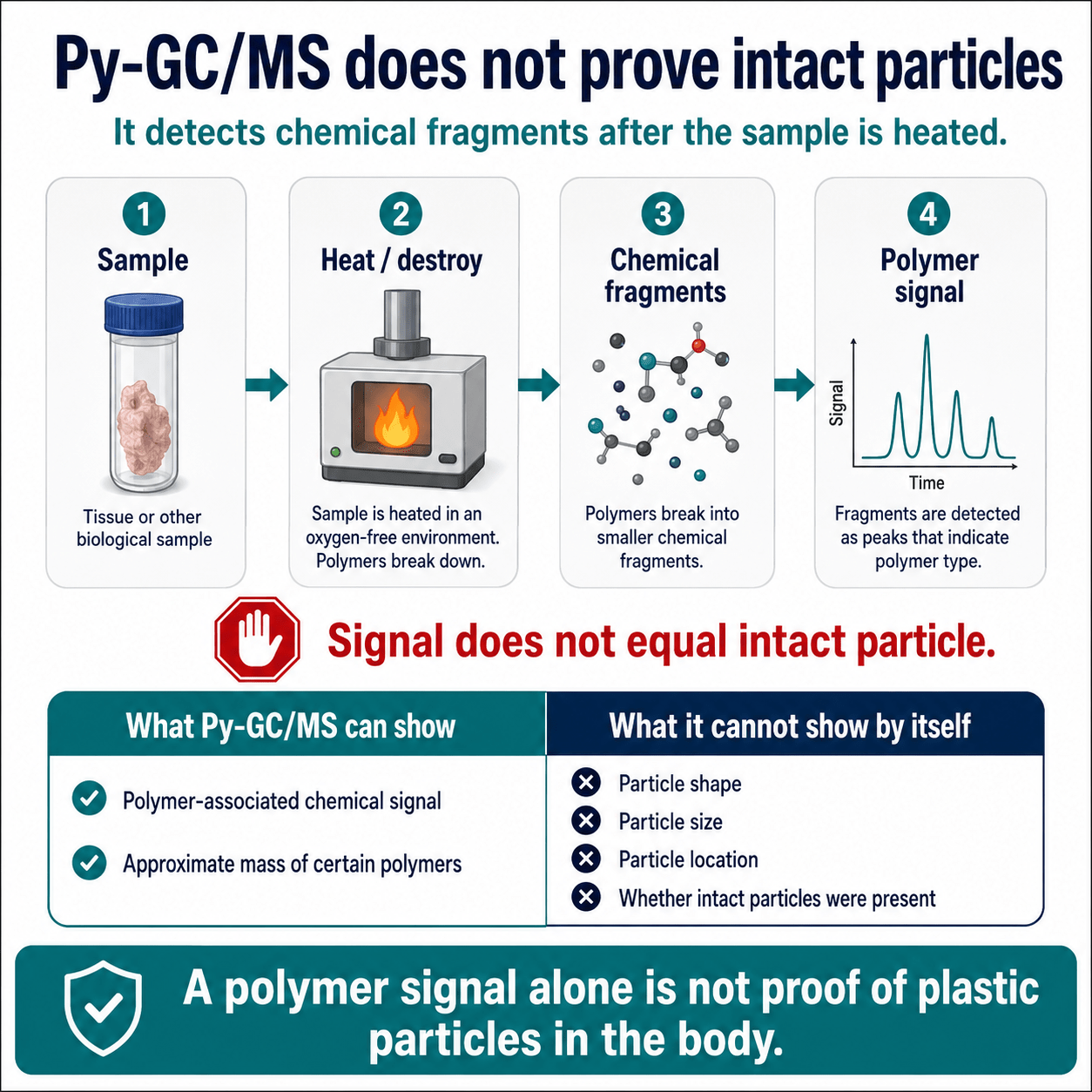
Py-GC:MS Does not Prove Intact Microplastic Particles
Can Raman spectroscopy identify very small particles reliably?
Bottom line: Raman becomes difficult for very small particles, especially below about 1 micrometer.
Small particles produce weak signals and are harder to distinguish from background material. Claims about nanoplastics or sub-micron particles need especially strong validation.
Sources: EFSA 2025; Li 2024; Jüngling 2026; Qian 2024; Meyns 2023
Can FTIR identify microplastics reliably?
Bottom line: FTIR can be useful for larger particles, but it has size limits and can misidentify difficult samples.
Reliability depends on particle size, sample preparation, spectral quality, library matching, and operator decisions. FTIR results should be supported by good blanks and transparent quality criteria.
Sources: EFSA 2025; Jüngling 2026; Koelmans 2019; Meyns 2023
How can contamination create false detections?
Bottom line: Plastic fibers and dust are common in labs, air, clothing, equipment, and sample handling.
Without strong procedural blanks and clean handling, a study may measure contamination introduced during collection or analysis instead of particles from the original sample.
One study cast doubt on prior studies by showing that gloves used in the laboratory shed a substance (lubricant) that is then detected and mistaken for plastic particles. They listed many studies that may prove to be not valid due to this newly found source of contamination.
Sources: Clough 2026; Koelmans 2019; Cowger 2020; Hermsen 2018
Why can solubles or precipitates create false positives?
Bottom line: Because dissolved substances can come out of solution and form particles during processing.
Those particles may look like microplastics or interfere with staining and spectroscopy. A study must prove the final particles are plastic, not precipitated salts, proteins, fats, residues, or other non-plastic material. This form of error applies in particular to studies on hot drinks.
Sources: EFSA 2025; Rauert 2025; Ranjan 2021
Does particle charge make microplastics or nanoplastics uniquely dangerous?
Bottom line: No. Surface charge is not unique to plastic particles, and charge alone does not prove risk.
Some recent claims argue that microplastics and nanoplastics may be especially hazardous because small particles can carry surface charge, form coronas, interact electrostatically with biological surfaces, or behave as colloids. Those are real particle-science concepts, but they are not unique to plastic. Clay minerals, silica, metal oxides, soot, cellulose fibers, natural organic colloids, humic substances, biological particles, and ordinary dust particles also carry surface charge or develop charge depending on pH, ionic strength, organic matter, weathering, mineral composition, and surrounding chemistry.
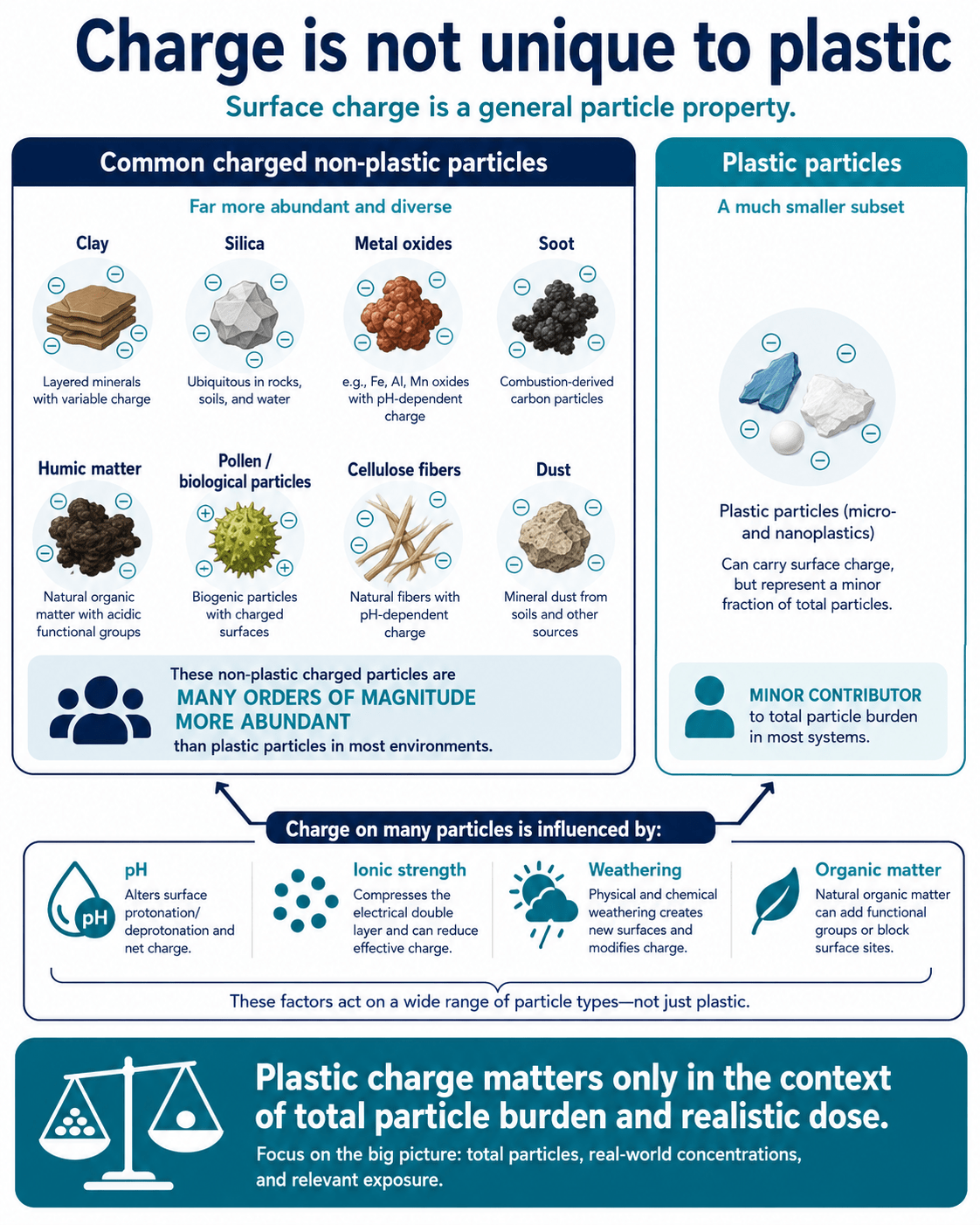
Surface Charge is Not Unique to Microplastic Particles
The relevant question is therefore not whether plastic particles can be charged. The relevant question is whether plastic particles contribute a meaningful fraction of total charged particle surface area compared with the vastly larger background of natural and non-plastic particles. Environmental and indoor particle mixtures are dominated by mineral dust, crustal material, combustion particles, road-wear particles, soot, fibers, biological material, skin fragments, silica, calcium carbonate, organic matter, and other non-plastic particles. Plastic is typically a small subset of total particulate exposure.
Charge-based claims therefore require the same evidence standard as any other microplastics claim: confirmed plastic identity, realistic particle size, realistic surface state, realistic dose, comparison with non-plastic particles, and demonstrated harm beyond ordinary charged mineral, organic, and biological particles. Without that comparison, “plastic particles are charged” is not a risk conclusion. It is only a generic property of particulate matter.
Surface charge, eco-corona formation, aggregation, and colloidal behavior can affect particle transport and measurement. They are legitimate reasons to improve analytical methods and reporting standards. They are not, by themselves, evidence that normal microplastic or nanoplastic exposure causes human disease.
Sources: Rahman 2024; Yang 2025; Gustafsson 2018; Mukherjee & Agrawal 2017; IARC 2012; WHO 2022
Why are particle counts often misleading compared with mass?
Bottom line: A huge number of tiny particles can still weigh almost nothing.
Public claims often sound alarming because they report counts, not mass. Risk depends on dose, and dose often requires mass, size, polymer, route of exposure, and biological effect. Counts alone do not prove danger.
Sources: EFSA 2025; Koelmans 2022; Welle 2018; Mohamed Nor 2021
What makes a microplastics study credible?
Bottom line: A credible study proves particle identity, controls contamination, uses realistic exposure, and avoids overclaiming.
Strong studies include clean sampling, procedural blanks, validated methods, clear size cutoffs, polymer confirmation, mass estimates where possible, realistic dose comparison, and conclusions that match the data.
Sources: EFSA 2025, Plastics Research Council; Koelmans 2019; Gouin 2022; Cowger 2020; Hermsen 2018
What are the strongest studies on microplastics risk?
Bottom line: The strongest studies use realistic exposure, validated identification methods, strong blanks, appropriate controls, and conclusions that match the data.
A strong study should identify the material correctly, compare the dose with real exposure, measure mass where possible, and avoid turning detection into proof of harm.
Sources: Koelmans 2022; WHO 2022; FDA 2024; SAPEA 2019; Hermsen 2018; Cowger 2020
What are the weakest types of studies?
Bottom line: The weakest studies use unrealistic doses, unrepresentative particles, weak controls, contamination-prone methods, or detection tools that cannot prove the particles are plastic.
These studies may be useful for method development or hazard screening, but they should not be used as proof of real-world human risk.
Sources: Lenz 2016; Gouin 2024; Hermsen 2018; EFSA 2025; Cowger 2020
How does this review grade microplastics studies?
Bottom line: Studies are graded by whether they prove plastic identity, avoid contamination, use realistic dose, measure mass where possible, use relevant particles, and show harm rather than merely detection. In addition, we have developed an impartial computer-based way to grade studies and eliminate human bias.
The goal is not to dismiss studies. The goal is to separate reliable evidence from weak claims.
Sources: Koelmans 2019; Koelmans 2022; Hermsen 2018; Cowger 2020; WHO 2022
Which organ-detection studies survive strict contamination-control and intact-particle verification?
Bottom line: This must be judged study by study.
A study should not be accepted merely because it reports plastic in a human tissue. It should prove that the material was plastic, that it was an intact particle, that contamination was controlled, that the size was measurable by the method used, and that the claimed amount fits realistic exposure.
Until a study passes those tests, the public answer should be: no, this is not proved. Lungs are the most plausible exception because people inhale dust, and dust can contain a small plastic fraction. Jenner 2022 gives relatively strong evidence for lung particles, but even that does not prove disease or body-wide accumulation. Many other claims of plastic particles in the body were put in question (Laforsch 2025).
The body also has normal particle-clearance systems. Inhaled particles deposited in the airways and alveoli can be trapped in mucus, cleared by the mucociliary escalator, or engulfed by macrophages. Geiser reviewed macrophage clearance of inhaled micro- and nanoparticles and noted that particles deposited in the airways and alveoli are readily taken up by resident surface macrophages. This process is part of normal lung defense. It does not mean that no particle can ever persist or cause harm, but it does mean that detection of a particle is not the same as accumulation, toxicity, or disease.
Sources: Hermsen 2018; Cowger 2020; Clough 2026; Rauert 2025; Jenner 2022; Laforsch 2025; Geiser 2010