
Plastics Research Council
Common Microplastics Claims & Public Interpretation
Do people eat a credit card of plastic every week?
Bottom line: No. The “credit card per week” claim is not credible.
A credit card weighs about 5 grams. Mohamed Nor et al. estimated adult intake at about 583 nanograms per day, or about 0.015 grams over 70 years before elimination and with only nanogram-scale retained burden (Mohamed Nor 2021). That is nowhere near 5 grams per week. The credit-card claim exaggerates exposure by enormous amounts.
Sources: Nor 2021; Cox et al. 2019; Welle 2018; Plastics Research Council; Cox 2019; Senathirajah 2021; Mohamed Nor 2021
Are there hundreds of thousands of particles in bottled water?
Bottom line: No reliable evidence shows that bottled water contains dangerous numbers of plastic particles. One study using a new method made a very high particle-count claim, but it has not been independently replicated. Even if the count were correct, particle count is not the same as danger.
A large count of extremely tiny particles can represent very little mass. A health claim also needs proof of particle identity, dose, biological uptake, and harm. Bottled-water particle counts alone do not show a health risk. Even if there were hundreds of thousands of nanoparticles in water, converting the reported particle counts and sizes into mass gives an estimated concentration around 10 ng/L, or about 0.000000001% by weight (calculated from Qian 2024). The plastic types discussed are the same food-contact polymers used in bottles and caps (Welle 2018; FDA 2024).
Sources: Qian 2024, Welle 2018; Jüngling 2026; Materic 2024; Schymanski 2018
Do microplastics carry toxic chemicals into the body?
Bottom line: No credible evidence shows that microplastics are an important toxic-chemical delivery pathway for humans at normal exposure levels.
Plastic particles can contain additives or sorb chemicals from the surrounding environment in principle. The practical question is dose: do microplastics deliver a meaningful chemical exposure compared with direct exposure from food, air, water, dust, medicines, cosmetics, consumer products, and the surrounding environment? Critical reviews and model-based analyses show that this has not been demonstrated for typical human microplastic exposure (Koelmans 2016; Bakir 2014; Teuten 2009; Gerdes 2019; Koelmans 2022).
In some experiments, plastic particles do not amplify chemical toxicity and may instead reduce short-term bioavailability by binding chemicals to the particle surface. Rehse et al. reported that microplastic particles reduced the short-term toxic effect of bisphenol A on aquatic organisms, and Kleinteich et al. found that sorption of PAHs to microplastics decreased their acute toxicity in zebrafish embryos. Other studies likewise show that the chemical-vector claim is not a simple one-way transfer from plastic to organism (Beiras 2018; Beiras 2019; Ziajahromi 2019).
These studies do not prove that microplastics are beneficial. They show that the simple claim “plastic particles carry toxic chemicals into the body” is scientifically incomplete. A valid vector claim must quantify the chemical mass on the particles, compare it with direct chemical exposure, show release under realistic biological conditions, and demonstrate harm at realistic microplastic doses. Additive questions should also be separated from particle questions: food-contact plastics and additives must comply with applicable food-contact regulations, but chemical-additive exposure is not the same question as microplastic-particle toxicity.
It is also important not to treat ordinary plastic products as if they all contain the same chemicals. BPA, phthalates, PFAS, flame retardants, pigments, stabilizers, monomers, oligomers, and leachables are different questions. Many are not present in most common plastics at all, and many are not unique to plastics.
Sources: Beiras 2018, Beiras 2019, Ziajahromi 2019, Welle 2018; Koelmans 2016; Koelmans 2022; Bakir 2014; Teuten 2009; Rehse 2018; Kleinteich 2018
Are alternatives to plastic always safer?
Bottom line: No. Alternatives are not automatically safer or better.
Glass, metal, paper, cotton, and other alternatives can increase weight, breakage, energy use, emissions, food waste, or other hazards. A fair comparison must look at total risk and life-cycle impact, not just whether an item is plastic. Copper from pipes or cookware can be toxic. There are studies showing heavy metals coming from stainless steel and glass containers and paper.
Sources: Simantris 2024; Reimann 2010; Krachler 2009; Turner 2019; Kamerud 2013; Veríssimo 2005; DeArmitt 2023; Franklin Associates 2018; Li 2024; Meng 2024; Voulvoulis 2019
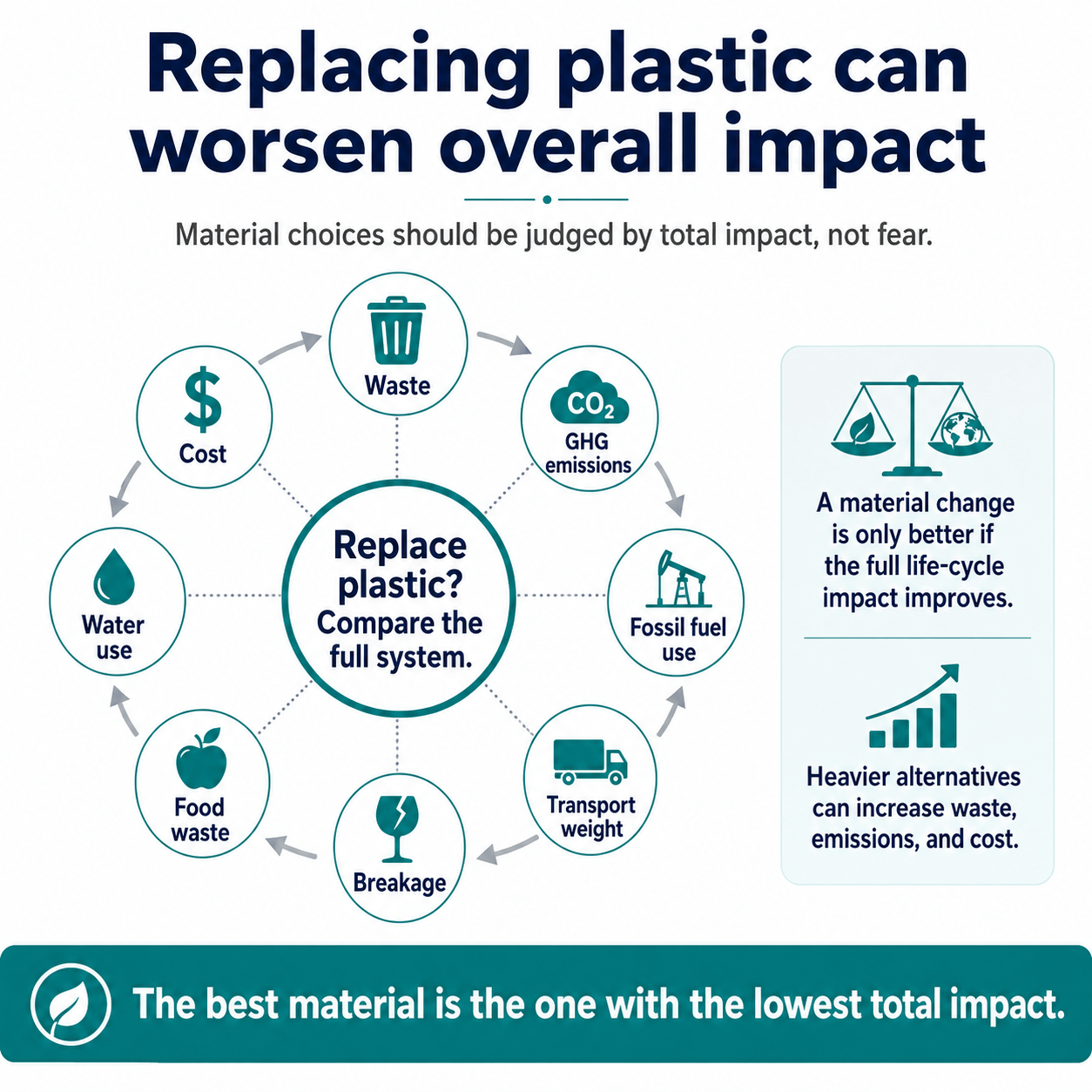
Replacing Plastic Can Increase Impact
Should plastic be avoided because of microplastics?
Bottom line: No. A plastic avoidance recommendation is unjustified. People can use plastics sensibly. Avoiding all plastic is shown to increase other risks or environmental impacts. Decisions should be based on measured exposure, proven risk, and full comparisons with alternatives.
Sources: Meng 2024; Voulvoulis 2019; Li 2024; Koelmans 2022; WHO 2022; FDA 2024