
Plastics Research Council
Dust, Textiles, and Exposure Reduction
Jump to a section
Are plastic particles a major factor in the context of dust as a whole?
Bottom line: No. Particle exposure should be judged in the context of total particulate matter, not plastic particles alone. Airborne and settled dust are complex mixtures of mineral dust, crustal material, combustion particles, soot, road-wear particles, textile fibers, skin fragments, pollen, cellulose, metals, salts, and other debris.
Particulate matter is a well-established health concern, but the major recognized sources are not plastic; global reviews identify crustal matter, road traffic, and fuel combustion as major particulate-matter sources (Mukherjee & Agrawal 2017). Dust deposition also varies strongly by season, elevation, weather, and local environment (Heindel 2020), and residential house dust contains a respirable fraction made up of mixed non-plastic material as well as fibers and other particles (Gustafsson 2018). Some non-plastic dusts, such as crystalline silica in the form of quartz or cristobalite, have established hazards at sufficient exposure (IARC Monographs 100C).
Concern should be proportional to the dose, composition, and toxicity of the whole particle mixture. Plastic particles are one small subset of total dust, and normal environmental plastic-particle exposure has not been shown to cause human health effects.
Sources: Mukherjee 2017; Heindel 2020; Gustafsson 2018, IARC
Are synthetic clothes a major source of microplastics?
Bottom line: Synthetic clothes can shed fibers, but that does not imply any health risk. Studies show the PET fibers to be non-toxic.
Fibers from clothing, carpets, furniture, and textiles can be found in dust and air. Natural fibers also shed. Cotton and wool have been reported to shed about 10-30x more fibers than polyester under some test conditions (De Falco 2020; Licina 2020). The key questions are the mass inhaled or ingested, whether fibers are plastic, and whether they cause harm at realistic levels. There is no evidence of harm.
Sources: FDA 2024, EFSA 2025, Merski 2008, Stock 2021; Suaria 2020; De Falco 2020; Licina 2020; Napper 2016
Do natural fibers like cotton and wool also shed particles?
Bottom line: Yes. Natural textiles shed fibers too.
People are exposed to cellulose, cotton, wool, skin flakes, food debris, and many other non-plastic particles. A scientific comparison should include all particles, not just plastic particles. Cotton and wool textiles have been reported to release about 10-30x more fibers than synthetic polyester under some test conditions (De Falco 2020; Licina 2020). This helps explain why one global ocean-fiber study found only about 8% synthetic fibers and about 92% natural fibers in oceanic surface waters (Suaria 2020).
Sources: Suaria 2020; De Falco 2020; D. Licina 2020; Athey 2022
What are the main sources of human microplastic exposure?
Bottom line: Likely sources include indoor dust, air, food, drinking water, packaging-related particles, textiles, and household abrasion.
The size of each contribution is still somewhat uncertain because studies use different methods and size cutoffs. Exposure should be described by mass as well as particle count.
Sources: Nor 2021; WHO 2022; Cox 2019; Eberhard 2024; Mohamed Nor 2021
Do people get more microplastics from food, water, or air?
Bottom line: The answer is still uncertain and depends on the method used.
The most comprehensive and credible review is from Nor who concluded that over 99% of exposure comes from ingestion and the rest from inhalation. The main finding was that total measured mass is small and no source has been shown to cause disease at normal exposure. Plastic particles are approximately one hundred thousandth of the total dust and particles we consume.
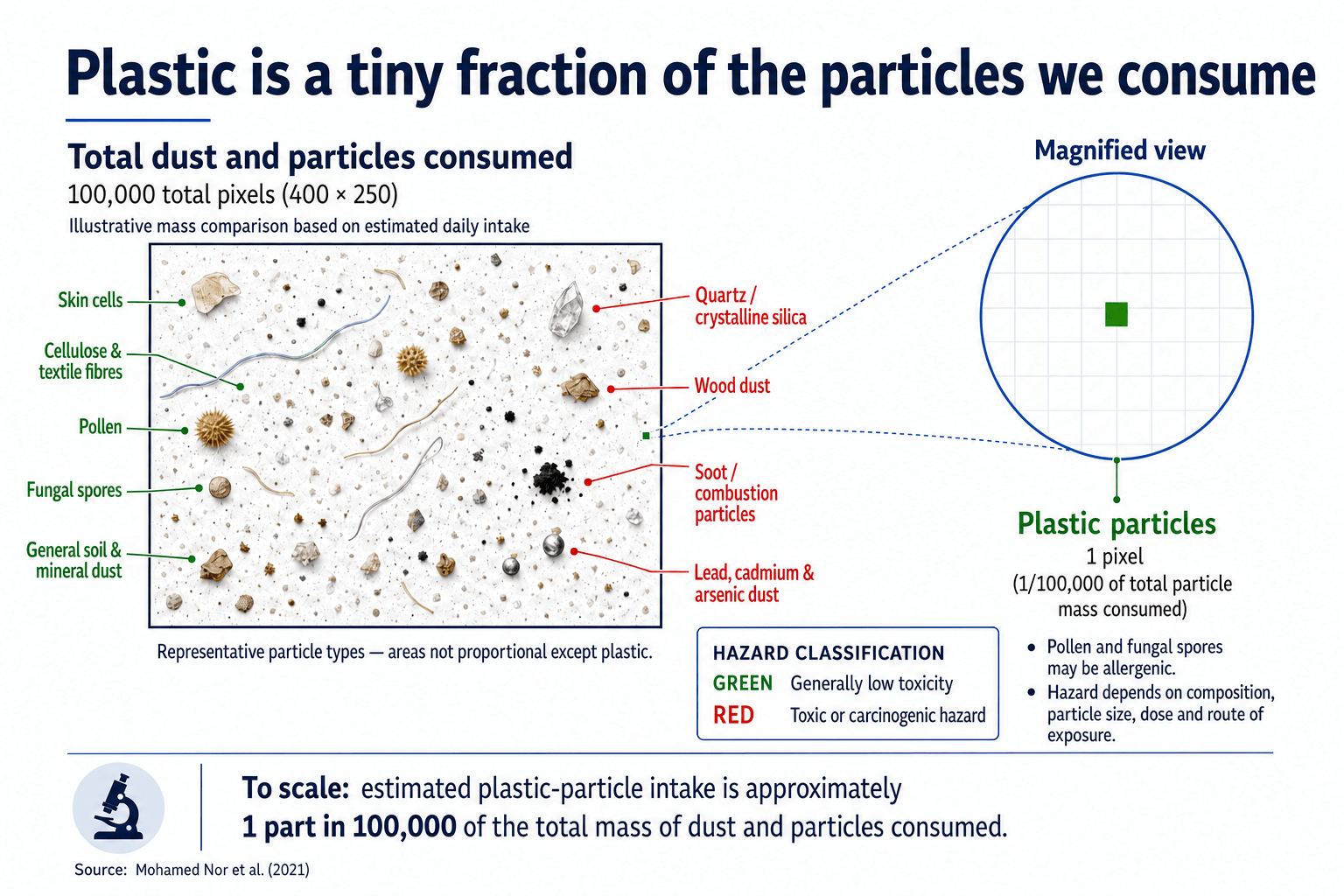
Microplastic Venn Diagram One Hundred Thousandth of Dust We Consume
Sources: Nor 2021; Cox 2019; Eberhard 2024; Mohamed Nor 2021; Catarino 2018
How much reported indoor and outdoor dust is plastic compared with cellulose, mineral dust, soot, skin particles, and other material?
Bottom line: Plastic appears to be a very small fraction of the total particles people breathe.
Outdoor plastic particles have been estimated to be extremely small compared with total dust exposure, around 0.01% of the total in some exposure comparisons (Mohamed Nor 2021; Eberhard 2024). Studies also show that most airborne and settled particles are not plastic (Vianello 2019; Yakovenko 2025; Wieland 2022). A fair risk comparison must include mineral dust, quartz, soot, cellulose, skin particles, natural fibers, food particles, and other debris. For indoor dust, plastics have been reported as a small fraction of total material, often around 1% or a few percent depending on the study and classification method (Vianello 2019; Khalid Ageel 2025; Yakovenko 2025). One study found plastic at about 4% of fragments and fibers, compared with about 91% proteinaceous material and about 4% cellulose (Wieland 2022).
This matters because some non-plastic particles are known hazards at sufficient exposure, while ordinary plastic dust has not been shown to cause human disease at realistic environmental levels.
Sources: Nor 2021; IARC Monographs on crystalline silica; Ogonowski 2018, Vianello 2019, Khalid Ageel 2025; Yakovenko 2025, Weiland 2022, Tan 2016; Dris 2016; Wieland 2022; Prata 2020
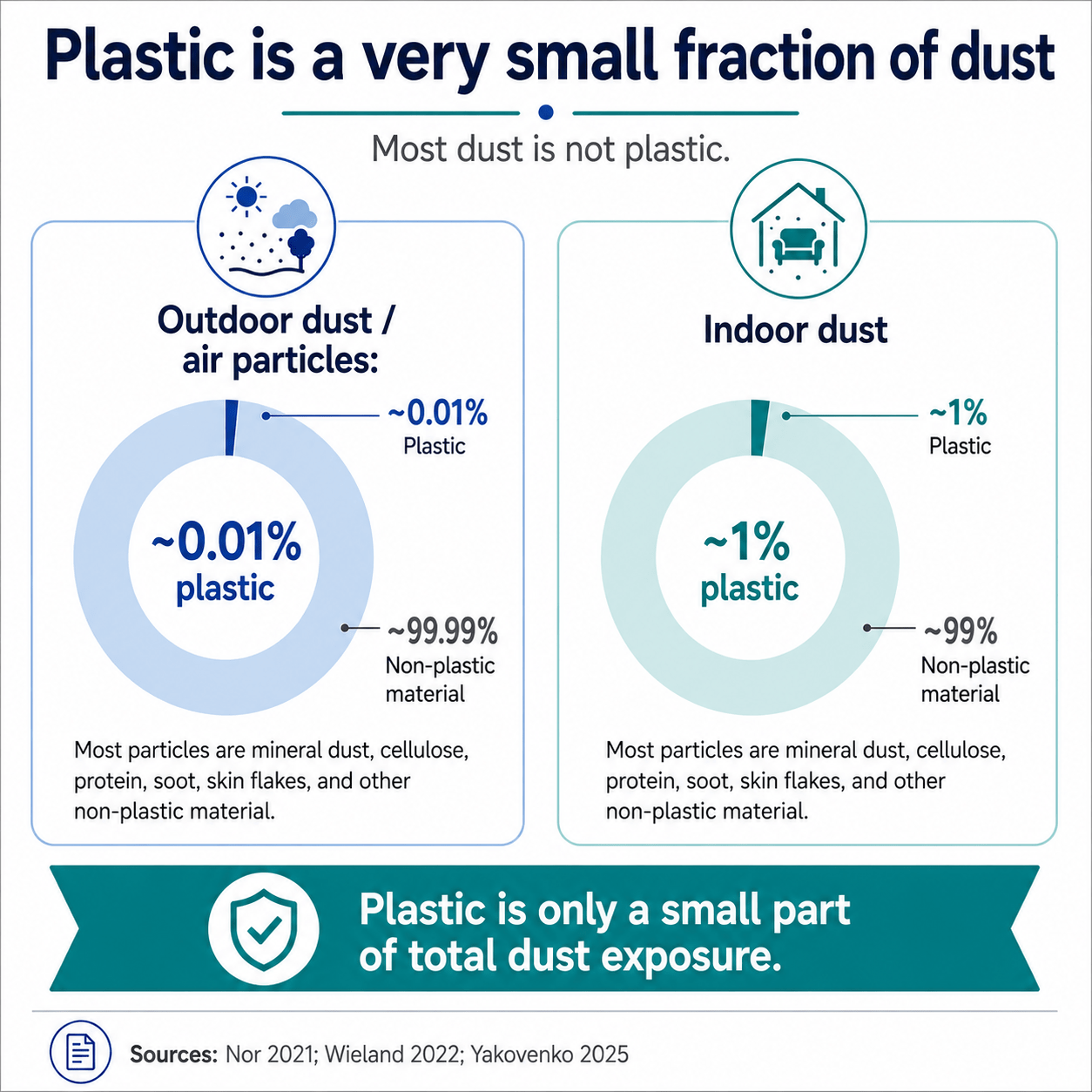
Microplastics are a Very Small Fraction of Particles in Dust
How do microplastics compare with other particles people inhale or ingest?
Bottom line: Plastic is only a small fraction of the particles people encounter.
People inhale and ingest mineral dust, cellulose, cotton, wool, skin flakes, food particles, soot, pollen, pigments, and other debris. Some non-plastic particles, such as crystalline silica or wood dust, have known hazards at sufficient exposure. Normal environmental plastic-particle exposure has not been shown to cause human disease.
Sources: Vianello 2019; Wieland 2022; Salthammer 2022; Yakovenko 2025; OSHA 2023; IARC 2012
Are natural particles automatically safer than plastic particles?
Bottom line: No. Natural does not automatically mean safe.
Quartz, asbestos, wood dust, soot, molds, pollen, and some metals can be harmful at sufficient exposure. Synthetic does not automatically mean dangerous. Risk depends on dose and toxicity, not whether the material is natural or synthetic.
Pollen is a clear example: it is natural, airborne, partly hydrophobic, and biologically active, and it has proven health effects in susceptible people, whereas ordinary environmental plastic-particle exposure has not been shown to cause human disease.
Sources: IARC 1995; IARC 2012; OSHA silica guidance; WHO 2022; FDA 2024; Wieland 2022
How does pollen exposure compare with airborne plastic particles?
Bottom line:
Pollen is a useful real-world benchmark because it overlaps in size with many coarse airborne microplastic particles, can occur at comparable or much higher airborne concentrations, and has proven health effects in susceptible people. By contrast, no adverse human health effect has been proven from ordinary environmental exposure to plastic particles at realistic doses.
Intact pollen grains commonly fall in the broad coarse-particle range of about 10–100 µm, overlapping with many larger airborne microplastic fibers and fragments. During pollen season, airborne pollen concentrations commonly reach tens to hundreds of grains per cubic meter and can reach thousands of grains per cubic meter during peak episodes. In an Atlanta field study, average daily total pollen concentrations across three sites ranged from 281 to 561 grains/m³, and peak pollen counts exceeded 5,900 to 8,800 grains/m³ depending on site (Jiang 2022). These concentrations are not unusual in pollen-exposure terms; some pollen-count systems classify tree pollen above about 90 grains/m³ as high and above about 1,500 grains/m³ as extremely high.
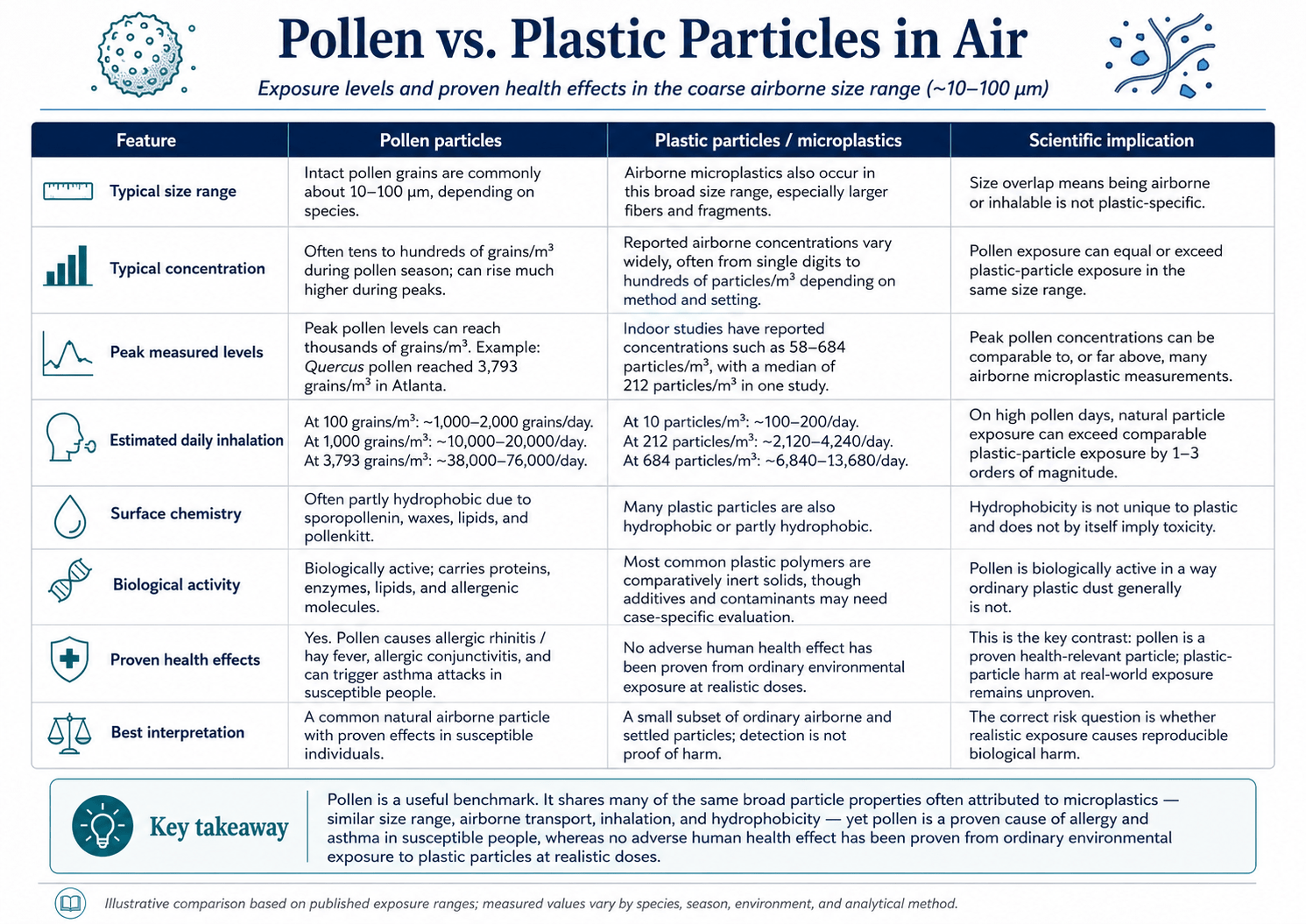
Microplastic Particles Amount and Health Effects vs Pollen
Airborne microplastic measurements are much more method-dependent. One indoor personal-exposure study reported average microplastic concentrations of 4.8 ± 1.6 MPs/m³ in houses, 4.2 ± 1.6 MPs/m³ in workplaces, 5.8 ± 1.9 MPs/m³ in subways, and 17.3 ± 2.4 MPs/m³ in buses, with most fibers and fragments below 100 µm (Torres-Agulló 2022). A later indoor study using Raman microspectroscopy reported higher indoor airborne microplastic concentrations of 58–684 MPs/m³, with a median of 212 MPs/m³, but also found that microplastics represented only 0–1.6% of non-plastic particles in the same environments (Maurizi 2024).
Using a simple adult inhalation range of 10–20 m³ of air per day, the comparison is clear. At 100 pollen grains/m³, a person may inhale roughly 1,000–2,000 pollen grains/day. At 1,000 grains/m³, the estimate becomes 10,000–20,000 grains/day. At 3,793 grains/m³, the estimate becomes roughly 38,000–76,000 grains/day. By comparison, airborne microplastic concentrations of 10 MPs/m³ correspond to about 100–200 particles/day, while 212 MPs/m³ corresponds to about 2,120–4,240 particles/day, and 684 MPs/m³ corresponds to about 6,840–13,680 particles/day. These are illustrative calculations, not universal exposure values, because both pollen and microplastic concentrations vary with location, season, weather, indoor activity, sampling method, and particle-size cutoff.
The health-effect contrast is more important than the particle count. Pollen is not merely a detectable natural particle. It is a proven biological allergen. In susceptible people, breathing pollen can cause allergic rhinitis, allergic conjunctivitis, and asthma attacks; CDC states that pollen exposure can cause hay-fever symptoms, allergic conjunctivitis, and asthma attacks when pollen is an asthma trigger. Allergic rhinitis is an IgE-mediated response to inhaled allergens and often co-occurs with asthma and conjunctivitis (Bousquet 2020).
This makes pollen a strong benchmark for interpreting microplastic claims. Pollen shares many properties often used to imply concern about microplastics: it is airborne, inhalable, environmentally widespread, partly hydrophobic, biologically interactive, and within the same broad size range as many coarse airborne particles. Yet pollen is the particle with proven health effects in susceptible people, while ordinary environmental plastic-particle exposure has not been shown to cause human disease. Therefore, the mere fact that plastic particles are detectable, airborne, hydrophobic, or inhalable is not evidence of hazard. The valid risk question is whether realistic exposure causes reproducible biological harm beyond the much larger background of ordinary non-plastic particles.
Sources: Jiang 2022; Torres-Agulló 2022; Maurizi 2024; CDC 2024; Bousquet 2020; WHO 2022; FDA 2024; Vianello 2019; Wieland 2022; Salthammer 2022; Yakovenko 2025
Are microplastics an indoor-air issue or an outdoor-air issue?
Bottom line: Most personal airborne-particle exposure occurs indoors because people spend most of their time indoors.
Indoor dust contains many particle types, including textile fibers, skin flakes, cellulose, mineral dust, and a small fraction of plastic. Reducing total dust is more rational than focusing only on plastic.
Sources: EPA Indoor Air Quality; Salthammer 2022; Vianello 2019; Eberhard 2024; Prata 2018
What should the public do to reduce microplastic exposure?
Bottom line: Use sensible habits to limit your exposure to all dust.
Reasonable steps include using normal ventilation and cleaning to reduce dust, but choosing water filtration only when it has validated performance. These steps should not be considered medical necessities.
Sources: WHO 2022; FDA 2024; EPA Indoor Air Quality; Salthammer 2022; Koelmans 2022
Which public exposure-reduction actions measurably reduce dose rather than merely reduce anxiety?
Bottom line: The most credible actions are the ones that reduce total dust and unnecessary abrasion.
Routine cleaning, ventilation, and sensible food-contact use are more defensible than fear-based rules such as avoiding all plastic. Many claimed exposure-reduction steps have not been shown to meaningfully reduce dose or improve health. Recommendations should be practical, measurable, and proportional to evidence.
Sources: WHO 2022; FDA 2024; EPA Indoor Air Quality; EFSA 2025; Cherian 2023
Are exposure-reduction products or detox claims legitimate?
Bottom line: Detox claims are not supported by evidence.
There is no credible “microplastic cleanse.” Fear-based marketing is not science. There is no medical reason to undertake any procedure claimed to remove particles, and every medical procedure entails risk.
Sources: FDA 2024; WHO 2022; FTC consumer-health marketing principles; Koelmans 2022