
Plastics Research Council
How to Evaluate New Microplastics Claims
What would count as proof that microplastics harm humans?
Bottom line: Proof would require confirmed particle identity, realistic exposure levels, reliable dose measurement, biological uptake at relevant sites, consistent health effects, and evidence that plastic particles caused the effect rather than merely being associated with it.
Detection alone is not enough. Association alone is not enough. High-dose laboratory effects are not enough.
Sources: Bradford Hill 1965; Koelmans 2022; WHO 2022; FDA 2024; Hermsen 2018; Cowger 2020
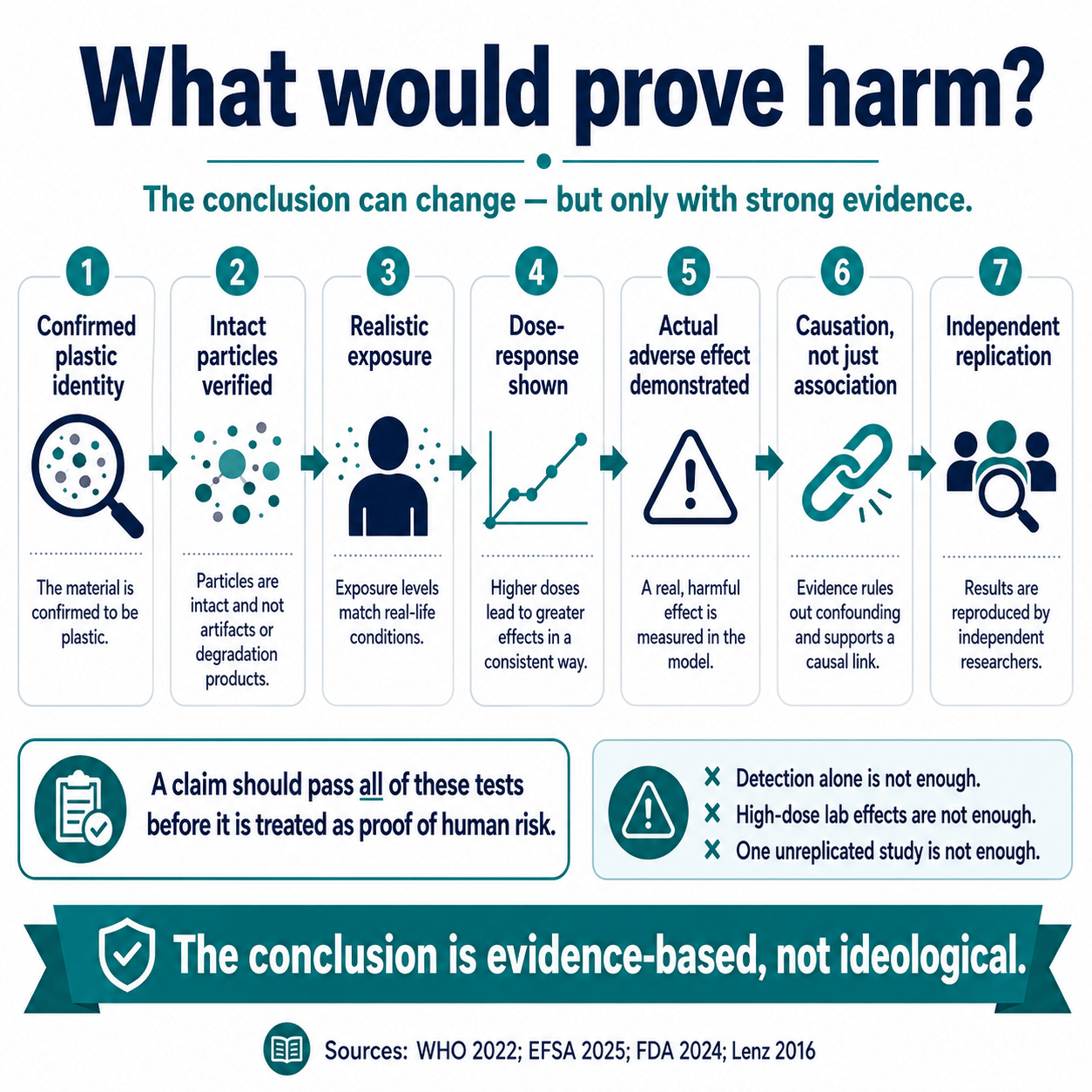
What Would Prove Harm from Microplastics Exposure?
What would change the conclusion?
Bottom line: The conclusion would change if high-quality studies showed confirmed plastic particles at realistic exposure levels causing reproducible harm in humans or credible animal models.
Current evidence does not show that. The review should remain open to better evidence while rejecting claims that do not fit the data.
A new claim should not be accepted just because it sounds alarming. Use this checklist before treating any claim as true.
· Did the study prove the particles were plastic?
· Did it prove they were intact particles, not dissolved material, additives, or contamination?
· Were procedural blanks and contamination controls strong enough?
· Was the dose realistic?
· Was the particle type realistic?
· Was the particle size measurable by the method used?
· Did the study measure mass, or only particle count?
· Did it prove harm, or only detection?
· Did it prove causation, or only association?
· Does the claimed amount fit known exposure estimates?
Sources: Bradford Hill 1965; Koelmans 2022; WHO 2022; FDA 2024; Ioannidis 2005; Goodman 1999