Plastics Research Council

Facts for a Brighter Future
An Independent Scientific Research Institute Formed to Share Peer-Reviewed Science on Plastics, Microplastics and Environment
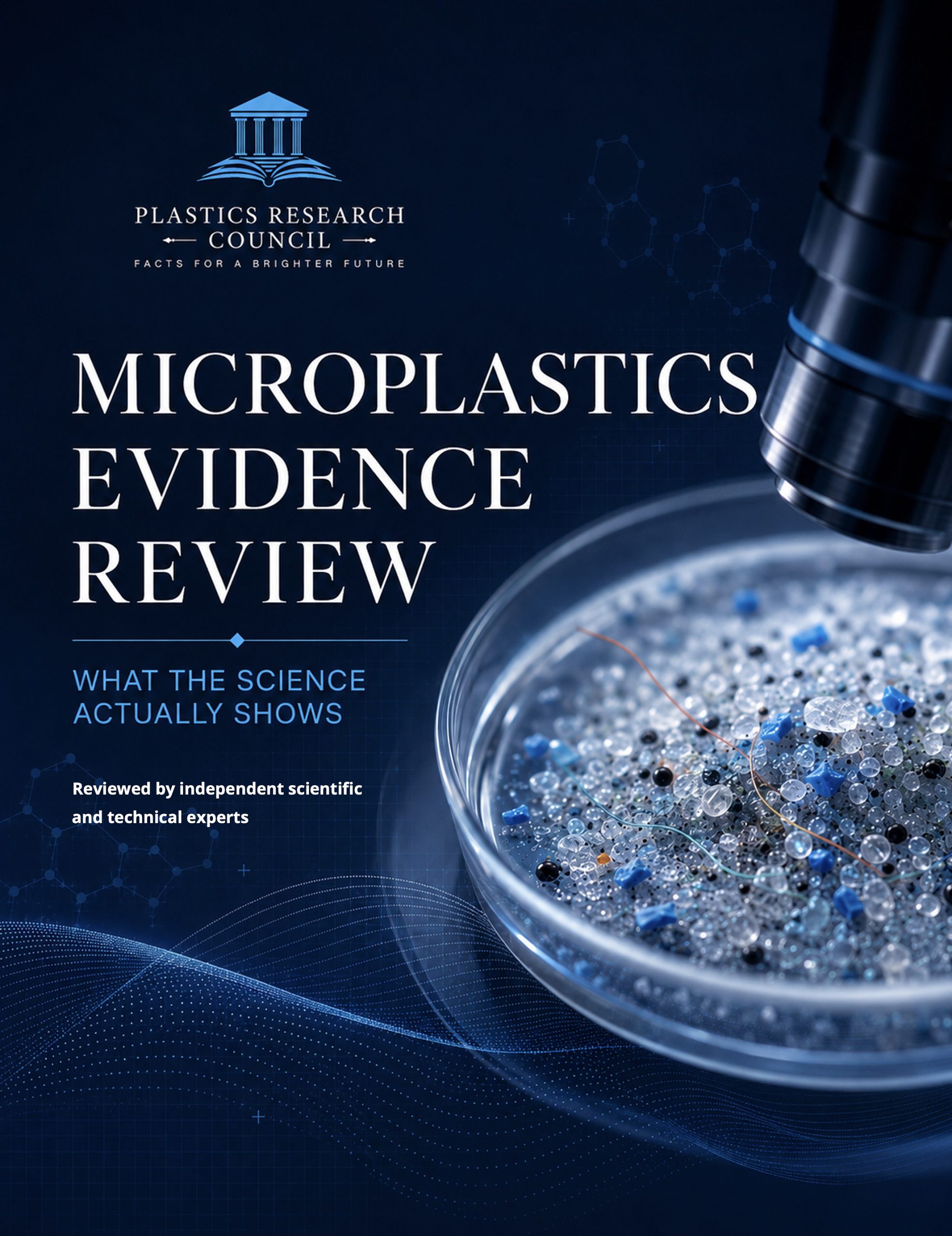
An independent scientific review of microplastics, human health, exposure, detection methods, and real-world risk
What the science actually shows – microplastics are now reported in air, water, food, dust, and biological samples. But detection is not the same as harm. This report examines what the evidence actually shows, what remains uncertain, and which claims are not supported by realistic exposure data.
Based on a review of over 700 peer-reviewed studies and endorsed by professors, toxicologists and professional scientists.
Key Finding
Current evidence does not show that normal real-world exposure to common plastic particles causes human disease.
That does not mean microplastics are never present. It means that presence, detection, particle counts, or high-dose laboratory effects should not be treated as proof of real-world harm.
What This Review Examines
This evidence review addresses the major public questions about microplastics:
- Are microplastics harmful to human health?
- How much microplastic are people actually exposed to?
- Have microplastics been found in blood, lungs, brain, placenta, stool, and other tissues?
- Do microplastics accumulate in the body?
- Are bottled water, tap water, food, dust, textiles, and plastic packaging important sources?
- Are plastic particles different from other particles?
- Do microplastics carry toxic chemicals into the body?
- Are alarming laboratory studies using realistic doses?
- Which detection methods are reliable, and which can give false positives?
- What evidence would be needed to change the conclusion?
The Short Answer
The review finds that many alarming microplastics claims fail for one or more of the same reasons:
- The dose is unrealistic.
Many studies use exposures far above measured human exposure. - Detection is not harm.
Finding a particle, polymer signal, or possible plastic fragment does not prove disease or risk. - Methods can give false positives.
Some reported detections rely on contamination-prone methods, indirect chemical signals, weak particle confirmation, or inadequate blanks. - Mass matters.
Particle counts can sound alarming, but the actual mass is often extremely small. - Plastic particles are only one subset of total particle exposure.
People already inhale and ingest many non-plastic particles, including dust, minerals, soot, fibers, pollen, skin cells, metals, and cellulose.
What Makes This Report Different
This review does not accept or reject studies based on whether they are favorable or unfavorable to plastics. Each claim is evaluated using the same evidence-quality questions:
- It separates detection from harm.
The report repeatedly distinguishes finding particles, polymer-like signals, or fragments from proving toxicity, accumulation, disease, or causation. That is the central error in much of the public microplastics narrative. - It uses dose and mass balance properly.
The corrected retained-burden sections are now strong. The report uses the Mohamed Nor estimate of about 0.015 g lifetime intake and ~40.7 ng modeled retained tissue burden by age 70, then correctly frames that as a tiny retained mass fraction. The “Most is not retained” and “6 g brain claim” graphics are now scientifically aligned with the text. - It puts plastic particles into total particle context.
Most reports discuss microplastics in isolation. This one compares them with mineral dust, cellulose, soot, pollen, spores, metal particles, glass, ceramics, wood dust, silica, pigments, road dust, and other ordinary particles. That is scientifically important because a particle cannot be treated as uniquely dangerous merely because it is plastic. - It evaluates mechanisms rather than repeating claims.
The section “Are plastic particles different from other particles?” is one of the strongest parts of the report. It correctly argues that inhalation, ingestion, inflammation at very high dose, chemical sorption, biofilms, surface charge, persistence, translocation, and environmental transport are general particle behaviors, not plastic-specific mechanisms. - It handles the strongest scare claims directly.
Brain, blood, placenta, arteries, bottled water, tea bags, cutting boards, tire particles, black plastics, and the “credit card per week” claim are all addressed in a way that asks the correct scientific questions: Was plastic confirmed? Were intact particles shown? Was contamination excluded? Was dose realistic? Was harm demonstrated? - It is unusually useful for real-world decision-making.
Many reviews stop at “more research is needed.” This report asks the more relevant public-health question: does the evidence support concern at realistic exposure? The answer it gives is clear, quantitative, and evidence-graded.
The report separates strong evidence from weak claims, detection from disease, association from causation, and high-dose laboratory hazard from real-world risk.
Reviewed by Independent Scientific and Technical Experts
The report was reviewed by independent experts with relevant experience in toxicology, medicine, polymer science, engineering, analytical methods, risk assessment, and life-cycle assessment.
Reviewer participation means the report was examined for scientific accuracy, balance, evidence quality, interpretation of the cited literature, and clarity of conclusions. Reviewer listing does not imply institutional endorsement unless explicitly stated.
Main Conclusions
- Microplastics are measurable, but measurement is not harm.
- Microplastics are widespread, but widespread is not the same as dangerous.
- Microplastics are particles, but particles are a normal part of everyday exposure.
- Plastic is a tiny component of total dust and particle exposure.
- Common plastic particles are among the lowest-toxicity particles people encounter.
- Normal real-world exposure is far below harmful-dose levels.
- Many alarming studies use unrealistic doses, artificial particles, weak controls, or methods prone to false positives.
- Detection in food, water, air, blood, organs, or the environment does not prove disease.
- Accumulation has not been demonstrated at meaningful levels.
- Microplastics are not proven to be an important toxic-chemical delivery pathway for humans.
- Avoiding plastics because of microplastics is not justified by current evidence.
- Public concern should be proportional to demonstrated risk, not to detection claims or media fear.
The scientifically justified conclusion is clear: there is no credible evidence that normal real-world exposure to microplastics harms human health, and there is no logical reason for the public to be concerned.
Suggested Citation
Plastics Research Council, Microplastics Evidence Review: What the Science Actually Shows, July 2026.

Information Gathering
Staying abreast of thousands of peer-reviewed studies on materials, waste, litter, ocean plastics, degradation, microplastics and more.

Independent Expert Analysis
Data is meaningless without expert analysis, and that is where our team of renowned international professors & scientists tell you what it means.

Solutions that Work
Once the facts are known, solutions that are proven to actually work can be identified and presented to the public, companies and policy-makers.
About Us
Plastics Research Council
Plastics Research Council provides evidence-based research on plastics, microplastics, packaging, recycling, sustainability, plastic waste, environmental impact, life cycle assessment, toxicology, exposure science, and policy.
We are an independent, science-led source of trusted information helping decision-makers, media, educators, policymakers, industry leaders, and the public separate plastics facts from plastics misinformation.
Our position is simple:
We are pro-evidence.
We are material agnostic.
In a debate often shaped by emotion, selective data, activist messaging, and incomplete science, Plastics Research Council provides research-based insight grounded in peer-reviewed evidence, environmental data, material science, human health risk assessment, and life cycle analysis.
We examine the full picture, including plastics and the environment, microplastics evidence, packaging sustainability, recycling and circularity, plastic waste and litter, carbon impact, chemicals and additives, regulation, policy, and comparisons between plastic, paper, glass, metal, compostable, and reusable alternatives.
Where claims are supported by strong evidence, we will say so.
Where claims are exaggerated, incomplete, misleading, or unsupported, we will challenge them.
The goal is to lower environmental impact and support solutions that genuinely reduce impact, protect human health, prevent waste, and deliver better outcomes based on facts rather than fear.
Follow Plastics Research Council for trusted facts, peer-reviewed research, and evidence-based insight on plastics, microplastics, packaging, recycling, sustainability, and the environment.










Quoted in the media: Washington Post, The Telegraph, Reader’s Digest, Food & Wine, Home & Garden, Medcity News, Livingetc, boredpanda, NTD (New Tang Dynasty), Stylist, EatingWell, Chowhound, Eco-Business, Plastics Technology Mexico, Exame, Plastics Today, Prevention Health News, Plastics Recycling Compendium, IOM3, NAPCOR, Washington Times, Globe & Mail, USA Today, Huffpost, The Epoch Times, CNN
Podcast appearances: Heretics with Andrew Gold, Gradical, Redefining Plastics, Bill Meyer Show, Ringside Politics, WCHE Morning Show, Bobby Gunter Walsch, Andy Caldwell Show, Mike Boyle Restaurant Show, Barry Dee WCHE, Detroit Morning News, Braun & Clark KBLU, Totally Iowa Politics KXEL, Rational Ground with Justin Heart, The Human Biography Podcast, Shawn E. Moore National Talk Radio, On the Edge Podcast Scott Groves, The Ray Richardson Show, Isaac Willour, Stories from the Top with Matt Scura, I Wish They Knew with Joe Hirsch, CFACT UN Treaty, Borderless Executive Search, The Starting Story Podcast, Xraised, The Advisor with Stacy Chillemi, The Agenda with Georgia Tolley, Growing Older Living Younger with Dr. Gillian Lockitch…


The Challenge
NGOs take the easy path by making emotion-based appeals for donations, even though their claims are not grounded in reality, and even though their misinformation makes matters worse for future generations.
Even the former President of Greenpeace left in dismay and outed them for peddling lies for donations, as detailed in his books. He went on to say that other household name “environmental groups” have sold out and abandoned their original raison d’être and now run get rich quick schemes instead.
Well-intentioned people give their hard-earned money to these NGOs, and competitors to the plastics industry are only too happy to help fund them too.
The plastics industry has been slow to react against this attack. At first they probably assumed that it would go away, and later they left it up to their trade associations to act, but they were let down.
Now, everyone has been hoodwinked by the propaganda machine. Our children are being taught nonsense at school and the public believe it too. We need to act now, before the situation gets even worse.
Call out misinformation
Set the record straight
Provide solutions that work
There is a path to a brighter future, but it is not an easy one, and that is for three reasons.
Firstly, it is difficult to change people’s minds, and they are already brainwashed against plastics because lies repeated often enough are believed.
Secondly, the anti-plastics campaign is very well funded. Michael Bloomberg for example proudly stated that he gave $85M to create groups including Beyond Plastics who have a mandate not to protect the environment but to make attacks on plastic materials use.
Lastly, making up misinformation is easy, but finding the facts is not. It takes thousand of hours to read thousand of studies in order to get to the truth.
The Solution
Information for Students & Teachers
Unbiased Expert Reports
Media Interviews
Advising Policy Makers
Call Now to Make a Difference
(601) 620-8080
Reviews
“These people mean business – not afraid to challenge the status quo and make a difference for the future generations”
“Could not be happier. I only wish I had found this organization sooner, as we have lost so much time to propaganda”
“Others let us down with empty promises but the PRC demolishes online nonsense and reaches the media with the facts”
Office Hours
Daily – 9:30 am to 5:30 pm (EST)