
Thank you for sharing this journey with me. While most people fear we are drowning in plastic and that there is no solution, we now know better. We have seen solid data distilled from thousands of studies spanning decades. The facts are known, and so are solutions that work, because once we truly understand a problem, the solution becomes obvious. Just like when we seek medical attention, suitable tests and accurate diagnosis favour a good prognosis. Here is a short recap of what we have learnt.
Materials Use
We now know that materials generate around 20–25% of greenhouse gas emissions and that reducing total materials use is a positive move. Plastics make up less than 1% of materials we use, either by weight or by volume, so if we really want to make a difference, then it is time to talk about the other 99% of materials, rather than obsessing over plastics to the exclusion of all else. Plus, replacing plastic with alternatives requires 3–4 times more material and would be a large step in the wrong direction.
There is a push to limit plastic production, but as we see, that would be a counterproductive policy because replacing plastic increases materials use by fourfold.
Waste
Waste generation mirrors materials consumption, which is logical when you think about it. Again, plastics represent under 1% of all waste and replacing them results in a 4-fold increase in waste. To illustrate this point, take your family to the kitchen and weigh a plastic bag, then a paper bag. Weigh a plastic straw, then compare it to one made of paper, metal, or glass. The results are profound and irrefutable.
Similar to the case for materials, limiting access to plastic materials or taxing them would push people to alternatives, which would result in a tremendous increase in waste.
Fossil Fuel
Plastics are maligned because they are made of fossil fuel, but a closer look reveals that to be an overly simplistic and misleading view. 85% of a barrel of oil is burnt, which truly is a waste of fossil fuel. In contrast, only around 5% is consumed to make plastics, which is a far wiser use of resources; also remember, at the end of life, plastic can still be burnt to recover the energy and make electricity. Not only that, but the net effect of plastics is to reduce fossil fuel use because they make cars, planes, and trucks lighter (for increased fuel economy), prevent food waste (from damage and spoilage), and insulate buildings so less energy is needed for heating. Alternative materials require far more fossil fuel to manufacture because they are more energy and resource intensive. Lastly, the majority of plastics can be made using plant-based oils instead of fossil fuel anyway, if we need to do that in the future. Such non-fossil plastic alternatives are already available at scale.
When it comes to fossil fuel, plastics production and use reduces fossil fuel use, so any action or policy that encourages a move to alternatives would be unwise and counterproductive.
Greenhouse Gas
Greenhouse gas (GHG) is one of the primary concerns for many. Here again, we find that the contribution of plastic has been grossly exaggerated. Plastic production creates about 3–4% of GHG, but plastic use reduces GHG by a larger amount by making vehicles lighter, preventing food waste, and insulating heat. If GHG is a concern for you, then the biggest improvements can be accomplished by driving less, flying less, and eating less meat. One return plane trip creates more GHG and uses more fossil fuel than a lifetime of PET bottles. For materials, concrete and iron/steel are by far the largest contributors, and that is where most of our efforts should be directed.
As we can see, when it comes to materials use, waste, GHG, or fossil fuel consumption, no one genuinely interested in making the world a better place would rant about plastics while completely overlooking the other 99% of the impact, and yet that is what we see today. Anyone with a genuine concern should check the evidence before deciding what to do — i.e. “check the facts before you act” — as I like to say. Acting on emotion before checking the facts often makes matters much worse, not better.
GHG mirrors the case of fossil fuel because burning fossil fuel creates carbon dioxide. The use of plastics is the best option for greenhouse gas reduction, so encouraging or forcing a move to other materials would be unjustified.
Mismanaged Waste: “Pollution” & Litter
There is mismanaged waste in the world, but solutions are known and already in place in many countries. We know that tax on the sale of goods can be used to provide waste receptacles, collection, and proper disposal. Some countries have not yet caught up, but the pathway is clear with no special technology needed.
Scientists have discovered that what people now call plastic “pollution” is simply items that were littered in one place, then moved. So, rather than being a problem caused by companies or materials, it is a problem created by human behaviour. That is important because we have proven solutions for litter, and they are education, deposits, and fines. Blaming companies or materials for litter is unjust and counterproductive.
Litter is caused by people, and the solution to littering is called “a bin,” plus encouraging people to use them.
Oceans
Claims that the oceans are choking in plastic are based on a wild, long-disproven guess. The idea that millions of tons of plastic enter our oceans every year was simply invented, and we are told such numbers to this day, even though multiple massive studies spanning decades show measured amounts that are low and not increasing.
A sea turtle would have to swim 100,000 miles to run across a piece of plastic bag, so every image you have ever seen of a turtle with a bag around its neck is a lie created in Photoshop. How can we create a better future based on fiction and scare tactics?
Sadly, attempts at regulation completely ignore abandoned nets and other fishing gear that are scientifically proven to be what causes harm to birds, turtles, whales, and other marine life. Instead, they plan to regulate the 0.03% of ocean plastic, like bags, straws, and bottles, which are not responsible for harm. What a tragedy, and yet that is what UNEP’s INC-4 and INC-5 are doing.
When it comes to the oceans, policies that would actually help are regulations on fishing nets to prevent them from being discarded, which harms marine life, as well as adjusting shipping routes to avoid whales and limiting ship speeds to reduce harm to them.
Degradation
We are told that plastics don’t degrade even though we see them degrade before our very eyes. There are thousands of studies spanning decades on plastic degradation. The global market for plastic stabilisers is in the billions of dollars per year. Why would anyone buy stabilisers for plastics if they really were stable? They wouldn’t. Plastics degrade rapidly, more rapidly than most materials (concrete, ceramics, glass, metals) and at a similar speed to paper and wood.
Luckily, we can tune the degradation rate of plastics with those stabilisers, so a thin shopping bag contains very little stabiliser and degrades quickly outdoors. A thicker plastic pipe contains much more stabiliser and better stabilisers while providing safe, clean drinking water with an expected durability of a hundred years or more. So, the idea that plastics are bad because they don’t degrade is both false and unjust discrimination.
Encouraging degradation is not a sound policy because it increases environmental impact. Durable materials tend to reduce impact. Also, degradation means converting plastic into carbon dioxide (a GHG) without capturing the energy. Burning them converts them to CO2 too, but at least then you can use the energy to make electricity, which makes more sense. Degradable materials also increase littering.
Toxicity & Microplastics
Pretty much everything is toxic when the concentration is high enough. That includes oxygen, table salt, and alcohol. So, how do common plastics compare? The answer is that decades of testing show them to be some of the safest substances we have. Long-term tests show them to be safer than alcohol, table salt, caffeine, or copper, to name just a few examples.
Plastic particles, aka microplastics, are as safe as clay (i.e. dirt) or cellulose, which is what plants and trees are made of. Exposure levels are incredibly low, and most particles pass right through us. It would take tens of thousands of years to ingest just 5 g of non-toxic plastic particles. Meanwhile, we ingest 200,000 times more inorganic particles, including proven toxins and cancer-causing substances. So, while dust can pose dangers, focusing on the plastics component is a red herring.
In fact, scientists found we are only concerned about microplastics in the first place because we have been misled by certain scientists and by the media. They made a big deal out of a small problem, probably to get rich and famous.
There is no new policy required here because there is already extensive regulation with ongoing testing to ensure our safety.
Life Cycle Analysis
Life cycle analysis (LCA) is the only way to know for sure how much impact each option causes (including GHG, fossil fuel use, pollution, waste, and more). It is standardised and has been honed over decades. Even so, there remains a temptation to cheat, and thus, it is wise to check every life cycle study, rather than relying on just one or two.
Looking at hundreds of LCAs, we find that plastic is the alternative that has the least impact in over 90% of applications studied. So, if you are not sure how to minimise your impact, then picking plastic is usually the correct choice, as proven by science.
It is not just packaging where plastic minimises impact; the same applies to water pipes, textiles, and many other use cases. One reason plastics minimise impact is that you can get the same job done using far less material, which is also why expanded polystyrene turns out to have such a low impact; after all, it is around 98% air.
It also turns out that the least impactful choice is also the least expensive, which is great news because you can help the environment and save money at the same time. Unfortunately, at present, people are spending more on alternatives that increase impact because they have been misled by NGOs, the media, and companies looking to sell products based on false advertising and greenwashing.
Any move to limit access to our greenest choice e.g. through plastic production limits, would be unjust and harmful, resulting in vastly more materials used, waste, litter, GHG, and fossil fuel use. The same applies to taxing plastic. Taxes focused on the lowest-impact choice would just drive people to alternatives that are scientifically proven to increase harm.
Recycling
The perception is that we desperately need recycling to reduce the use of virgin plastic, to make plastics green, and to prevent litter. In reality, life cycle analyses show that plastics are often the lowest-impact option even with low or no recycling. Recycling is like the icing on the cake because it makes the impact of plastics even lower.
There is no correlation between recycling and litter because people choose to drop litter whether or not it can be recycled. Solutions to littering revolve around changing human behaviour, as mentioned previously.
The public is unaware that plastics recycling is well established and works well on a large proportion of common plastics like PE, PP, PET, PS, and PVC, which further reduces the energy needed by 70–80% compared to virgin (new) plastic. Mechanical recycling works and is the correct approach.
We are told by people trying to sell glass bottles or aluminium cans that we should pick that material because of a higher recycling rate, but that is a false argument. We should instead choose the material with the lowest impact then recycle that. That is the way to save the environment and save some money at the same time.
Misinformation
With the advent of social media, it has never been cheaper and easier to spread misinformation. Surveys show that people have little trust in the media, and yet they have formed strong opinions about plastic based exclusively on myths from the very media they do not trust.
Today, every layperson seems to think that their opinion is as accurate as the opinions of actual experts. People who have never read a single study are happy to tell a scientist who has read thousands of studies that the scientist is wrong. Such delusional thinking is unhelpful and betrays an ego that is completely out of control. Instead, the level of conviction we have on a topic should be proportional to the amount of evidence we have to support that conviction.
Speaking of convictions, it would be helpful if we saw some charlatans at NGOs, in the media, and in the greenwashing companies fined and convicted for their deeds against society. Perhaps ensuring there is a price to pay would make them think twice.
The plastics industry needs to do vastly more to share the science, not to “defend” plastics but simply to set the record straight. They need to push their trade associations to do their job and spend their resources on this vitally important activity.
Closing Thoughts
Since I wrote The Plastics Paradox, so much has happened. New allegations have been made against plastics, and I have spent thousands of hours unfunded, checking the science to see whether the allegations are justified. This completely new book examines the public perception of plastic and compares perception to reality, i.e. what the peer-reviewed scientific evidence has to say.
Looking at plastics in isolation leads to incorrect conclusions. Therefore, the book takes a holistic view, including the impact of plastic materials relative to other materials and the consequences of replacing plastic with alternatives. This allows us to identify solutions proven to decrease impact and help preserve the environment.
There is a famous quote from George Bernard Shaw that goes like this:
“Two percent of the people think; three percent of the people think they think; and ninety-five percent of the people would rather die than think.”
If you have read this book, then you are the 2%, and I salute you. However, that places a great responsibility on you because, with the rest of society flying on autopilot, we are the few who must make an outsized effort to preserve and protect our environment for future generations.
As we stand at the crossroads of environmental progress, we must confront an uncomfortable truth: much of what we believe about plastics is rooted in misinformation. The data is clear — plastics, when used and managed responsibly, are not the villains they have been portrayed to be. Instead, they are a vital tool in creating a sustainable future.
Imagine a world where decisions are guided by evidence, not fearmongering. Where the focus shifts from vilifying plastics to addressing the real issues — mismanaged waste, ineffective recycling systems, and the human behaviours that cause litter. This is a world in which we harness the unique advantages of plastics to reduce greenhouse gas emissions, prevent food waste, and create innovative solutions for everyday challenges.
Throughout this book, we’ve seen how misinformation has steered public opinion and policy in the wrong direction. Powerful entities have exploited good intentions to mislead, distract, and profit, while real solutions have been ignored. But there is hope. By embracing science and rejecting sensationalism, we can reclaim the narrative and ensure that decisions are driven by facts, not fear.
To my daughters, and to the generations that follow, I want you to know that science holds the key to progress. Truth, backed by rigorous research, has the power to dispel myths and pave the way for meaningful change. It is our duty, as stewards of this planet, to seek out that truth, challenge deceptive narratives, and make choices that benefit both humanity and the environment.
The responsibility lies with all of us. For policymakers, it means crafting regulations based on comprehensive data rather than sensational headlines. For industries, it’s about continuing to innovate and prioritise sustainability. For individuals, it’s a call to reject misinformation, recycle responsibly, and hold ourselves accountable for the waste we produce.
So, I leave you with this: What kind of future do we want to create? One dominated by fear and falsehoods, or one where informed decisions lead to progress and prosperity for all? The answer lies in your hands.
Keynote Talks
Bring the Visionary Behind This Book to Your Next Event. Are you looking for a keynote speaker who will challenge conventional thinking, inspire meaningful action, and deliver a message backed by scientific evidence? Dr. Chris DeArmitt, world-renowned independent plastics expert and author of The Plastics Paradox and Shattering the Plastics Illusion, is your ideal choice. With a track record of captivating audiences across the globe, Dr. DeArmitt brings clarity, passion, and cutting-edge insights to one of the most misunderstood topics of our time.
In his keynote talks, Dr. DeArmitt dismantles popular myths about plastics using peer-reviewed science, presenting the data that environmental NGOs and the media often ignore. His presentations are not only enlightening but also actionable, showing how individuals, organisations, and governments can make better choices for both the environment and society.
With humour, real-world anecdotes, and a passion for truth, Dr. DeArmitt captivates audiences while challenging them to think critically about the narratives they’ve been told. Whether addressing corporate leaders, policymakers, or educators, Dr. DeArmitt customises his presentations to meet the unique needs of your audience. Packaging, PET bottles, PS foam, plastic pipes, and microplastics are just a few potential focus areas, or request another topic to suit your circumstances.
By hiring Dr. Chris DeArmitt, you’re putting your audience on the path toward a brighter future.
Let’s shape a better tomorrow, one fact at a time. Book Dr. DeArmitt for your next event today!
+1 601 620 8080
Biography
Chris is considered one of the top plastic materials scientists and problem-solvers in the world, which is why companies like Apple, P&G, LEGO, iRobot, Eaton, Total, and Disney come to him for help.
A deep understanding of materials combined with a highly creative mind allows Chris to quickly solve even the toughest challenges. To offer only one example, he solved a serious production issue that had plagued BASF for 30 years and cost them millions.
He has also received six open innovation cash prizes, placing him among the top 0.01% of innovators. In 2016, he published the book Innovation Abyss, which reveals the true reasons for innovation failure and the proven path to success.
In 2018, Chris was featured on CBS’s 60 Minutes with Scott Pelley as an expert witness in a class-action lawsuit related to Marlex mesh plastic implants. He helped thousands of women get settlements. Later television appearances include Sky News and the BBC, as well as assorted radio and internet media interviews.
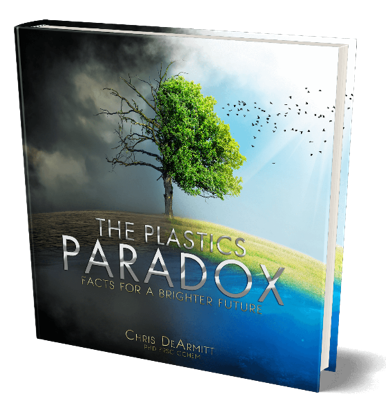
In 2020, Dr. DeArmitt published The Plastics Paradox, the first comprehensive, scientific overview of plastics materials and the environment covering all topics, including waste, litter, microplastics, degradation, ocean plastics, and more.
In 2024, Chris founded The Plastics Research Council, a nonprofit organisation supported by an international team of respected scientists with a mandate to provide accurate, unbiased information about plastics and the environment.
 Chris has a multitude of granted patents, plus numerous articles, book chapters, encyclopaedia chapters, and conference presentations to his name. He is an award-winning keynote speaker educating global audiences on plastic materials science and dispelling myths about the environmental effects of plastics and microplastics.
Chris DeArmitt PhD FRSC FIMMM CChem
President, Phantom Plastics LLC
Phone: +1 601 620 8080
E-mail: chris@phantomplastics.com
Shattering the Plastics Illusion Back Cover
Imagine being equipped with the ultimate toolkit to tackle one of the most complex challenges of our time. Shattering the Plastics Illusion builds on the groundbreaking success of the original The Plastics Paradox (2020), delving deeper into the truths and untangling the myths that have clouded the conversation. Drawing from over 5,000 scientific studies, this authoritative guide provides a comprehensive, nuanced exploration of key issues—from materials use and waste management to the environmental impact of microplastics.
In this compelling narrative, Dr. Chris DeArmitt inspires readers by guiding them through thorough, peer-reviewed research. Renowned for his tireless dedication to uncovering facts and exposing misinformation, Dr. DeArmitt brings clarity to confusion, revealing the evidence we need to make smarter, more sustainable choices. His engaging style, backed by decades of expertise and recognition from global media outlets like the BBC, CBS 60 Minutes, Sky News, France 24 TV, The Telegraph, USA Today, and The Washington Post, captivates audiences across the globe.
In 2024, Dr. DeArmitt took his mission to the next level by founding The Plastics Research Council, assembling a powerhouse team of respected scientists to deliver unbiased, trustworthy insights. Whether you’re a policymaker, an environmentalist, or simply a curious individual, this book will leave you enlightened, inspired, and ready to contribute to a brighter, cleaner future.
Break free from misinformation. Discover the truth. And join the movement for evidence-based solutions.